
Over the past few years, we have seen AI move from experimental to practical. What once felt like a future idea is now part of everyday work. 82% of business leaders believe we have reached a make-or-break moment for rethinking how organisations operate. That figure comes from the Microsoft Work Trend Index 2025, a study of over 31,000 knowledge workers across 31 countries. The message is clear: organisations that move deliberately with AI now will hold a significant advantage over those that do not.
In 2025, Microsoft introduced a concept that goes beyond tools and features. It launched Frontier Firm, a framework that aims to reshape how organisations work, innovate, and grow with AI.
Essentially, Frontier focuses on building systems that collaborate with people, backed by robust cloud and data infrastructure.
At Mazik, we often speak to organisations that are no longer asking whether AI is worth pursuing. Instead, they are asking how to move from careful experimentation to something that holds up in real, day-to-day operations. The Microsoft Frontier framework provides a clear and practical answer to that question.
| 71% of Frontier Firm leaders say their company is thriving, vs 39% globally | 93% say they are more optimistic about future work opportunities, vs 80% globally | 55% say they are able to take on more work, vs 25% globally |
Source: Microsoft Work Trend Index Annual Report, 2025
“In Frontier Firms, employees do not just use AI. They lead teams of intelligent agents, guiding these tools to achieve business goals faster and more effectively.” — Microsoft, Becoming an AI-first Frontier Firm
Microsoft Frontier is not a single product or a new platform. It is an operating philosophy, a framework for how organisations can work effectively with AI over the long term. Microsoft Frontier Programme is Microsoft’s approach to building organisations that can work effectively with AI. It brings together three essential elements:
Rather than adding AI on top of existing systems, Frontier encourages organisations to rethink workflows across teams and departments. The goal is not to replace people but to support them by removing friction, improving decision-making, and creating space for higher-value work.
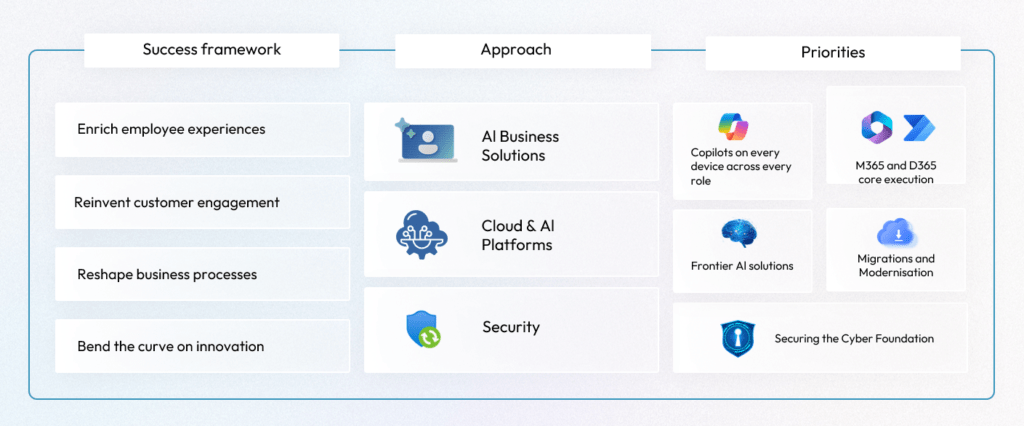
Microsoft has defined four outcomes that together describe what becoming a Frontier Firm looks like in practice. These four pillars form the core of the AI transformation success framework, and each one is grounded in real-world outcomes from organisations that are already putting it to work.
| 01 – Enrich Employee Experiences: Frontier Firms use Copilot and AI agents to remove the friction that drains people’s time and energy. Routine tasks are automated, analysis is deepened and democratised, and employee learning is supported through intelligent tools. As a result, people spend more of their working day on judgment, creativity, and the conversations that actually move things forward. The goal is not to replace roles but to make every role more rewarding and sustainable. |
| 02 – Reinvent Customer Engagement: The way organisations interact with customers is changing fundamentally. Frontier Firms use AI to respond faster, personalise more consistently, and maintain a quality of service that scales without proportionally scaling headcount. Furthermore, they use data from customer interactions to continuously improve, rather than relying on periodic reviews. Customer engagement becomes measurably better over time by design. |
| 03 – Reshape Business Processes: Many organisations’ processes were designed for a different era. Frontier Firms use AI to identify where those processes are slow, inconsistent, or unnecessarily manual, and then rebuild them around intelligent workflows. Specifically, connecting Microsoft 365, Dynamics 365, Power Platform, and Azure into a coherent operating environment where data flows freely and decisions happen faster. The result is an organisation that can outpace change rather than react to it. |
| 04 – Bend the Curve on Innovation: Perhaps the most significant shift is in how Frontier Firms approach new ideas. By reducing the time people spend on administration and repetitive tasks, they free up capacity for genuine strategic thinking. Moreover, Microsoft Copilot Studio and Azure AI Foundry allow teams to build and test new solutions without waiting for large IT projects. Innovation becomes a continuous, distributed activity rather than something that happens in dedicated programmes. |
The above four pillars are not a sequential checklist. They reinforce each other. An organisation that enriches its employee experience tends to see improvements in customer engagement as a direct consequence. A business that reshapes its core processes creates the conditions for innovation to accelerate. Accordingly, the most effective Frontier Firms pursue all four in parallel, with a clear sense of where to focus first.
According to the Microsoft Work Trend Index 2025, 68% of organisations are now using AI in some form. However, the way they are using it varies enormously. Frontier Firms are not simply doing more with AI. They are doing it more deliberately. On average, they deploy AI across seven business functions, with more than 70% having embedded it into customer service, marketing, IT, product development, and cybersecurity.
Furthermore, the outcomes are measurable. Frontier Firms report better results than slower adopters at a rate four times higher across brand differentiation, cost efficiency, top-line growth, and customer experience. They are not automating for the sake of it. They are using AI to remove friction from the things that slow their people down most.
The mindset shift, nevertheless, is often the hardest part. Technology can be deployed relatively quickly. Changing how people work, how decisions are made, and how teams are organised takes considerably longer. That is precisely why Microsoft has framed Frontier as a cultural and strategic shift, not merely a technical one.
A defining feature of how Frontier Firms operate is the use of AI agents. These are not chatbots in the traditional sense. They are tools designed to carry out specific, contextual tasks within real workflows. Summarising a meeting and surfacing the actions. Drafting a first response to a customer query. Flagging a compliance risk before it reaches a decision-maker. Analysing data and presenting it in a format that supports a specific business question.
At Microsoft Ignite 2025, Microsoft highlighted how Copilot and agent capabilities are becoming part of everyday work across roles. Today, over 90% of Fortune 500 companies utilise Microsoft Copilot, and more than 800 million people engage with Microsoft’s AI-powered features every month.
In real terms, this means teams can spend less time on administration and more time on thinking, planning, and problem-solving. For example:
This is not about removing people from the process. It is about giving them better tools to do their work well.
One of the most practical aspects of the Frontier framework is that it applies across every business function, not just technology or operations teams. Whether the priority is cost reduction, faster content production, better recruiting, or smarter compliance management, there are specific agent use cases available within the Microsoft ecosystem today.
| Marketing: Increase revenue and optimise budgets ● Research agent: Deepen customer insights and inform strategy from live market signals ● Campaign manager: Automate campaign planning, execution, and performance reporting ● Production assistant: Generate and quality-check content quickly and accurately at scale |
| HR: Reduce costs and help employees thrive ● Ask HR agent: Enable self-service employee support for common queries and processes. ● Candidate search and selection: Accelerate and optimise recruiting with AI-assisted shortlisting. ● Career development assistant: Cultivate talent with tailored learning and opportunity matching |
| Legal: Minimise costs and reduce risk ● Contract management: Streamline contracting workflows and increase accuracy across reviews. ● Compliance and risk management: Align with regulatory standards and automate audit processes ● Ask Legal agent: Augment human-led advisory services with intelligent, contextual assistance |
The above use cases are drawn directly from Microsoft’s published guidance. For the full breakdown by function, see Becoming an AI-first Frontier Firm (Microsoft, 2025).
AI agents are only as effective as the data they can access. This makes data quality, structure, and governance central to the Frontier Firm model.
Organisations that succeed with AI typically invest in:
Within the Microsoft ecosystem, services such as Azure, Microsoft Fabric, and One Lake help organisations build a connected data platform that supports intelligent workflows. Organisations that skip this step often find that their AI tools produce unreliable outputs. By contrast, those who invest in their data foundation before scaling AI adoption tend to see more consistent results and a much smoother path from pilot to production.
Frontier is also changing how roles are defined and how work is structured. A recent survey found that 78% of UK senior business leaders say their organisations already use AI agents in their workflows, and 84% intend to train employees on AI within the next year to support this shift. Additionally, many executives recognise that AI will transform organisational structure and how people are deployed across roles. As Microsoft’s Becoming Frontier narrative highlights, customers across sectors are already seeing measurable benefits by integrating AI and agents into critical processes. Organisations that use AI to analyse data and generate insights can focus more energy on strategic priorities rather than transactional tasks.
This shift changes the nature of work & provides the following benefits:
Frontier is more than a set of products. It is a new approach to how businesses think about work, data, and digital capacity. It reflects a broader cultural shift where human ambition and machine intelligence work together. This has parallels with past technology disruptions, where early adopters gained a clear advantage by reimagining how they operate.
From a practical perspective, becoming a Frontier Firm means:
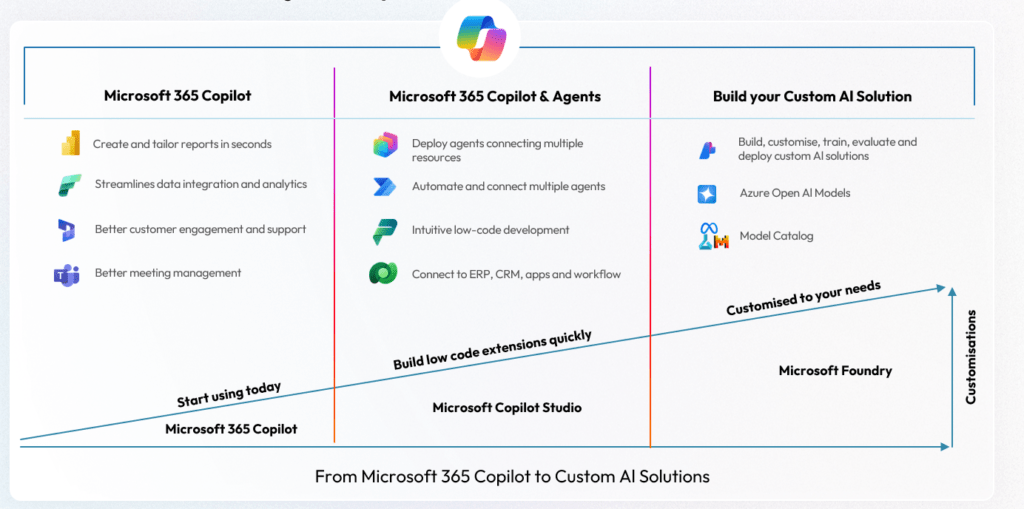
Microsoft has mapped out what the journey from first steps to full-scale capability looks like in practice. Rather than presenting AI adoption as a single destination, the framework recognises that organisations move through three distinct stages. Understanding which stage you are at is the first step towards knowing what to do next. You can explore the full journey through the Microsoft Frontier Programme.
| Stage 1 Microsoft 365 Copilot | • Create and tailor reports in seconds using live organisational data • Streamline data integration and analytics across your Microsoft environment • Improve customer engagement and support through faster, more consistent responses • Better meeting management, including automated summaries, actions, and follow-ups |
Most UK organisations are at or near this stage. Microsoft 365 Copilot is available today and requires no custom development. It is the most accessible entry point into the Frontier model and, for many teams, the place where the value of AI becomes tangible for the first time.
| Stage 2 Copilot & Agents + Copilot Studio | • Deploy agents that connect multiple data sources and business systems • Automate and connect multiple agents across departments • Build low-code extensions quickly using Microsoft Copilot Studio • Connect AI workflows directly to ERP, CRM, and operational applications |
At this stage, organisations move from using AI as a personal productivity tool to embedding it into shared workflows and operational systems. Copilot Studio provides a low-code environment that enables teams to build and deploy agents without large IT projects. Furthermore, this is the stage at which AI starts to change how teams work together rather than simply how individuals work alone.
| Stage 3 Custom AI + Microsoft Foundry | • Build, customise, train, evaluate, and deploy custom AI solutions • Access Azure OpenAI Models for sector-specific applications • Use the Model Catalogue to find and deploy the right model for your context • Create bespoke AI capabilities that are unique to your organisation |
This is where Frontier Firms operate at their most competitive. Custom solutions built on Microsoft Foundry and Azure OpenAI allow organisations to address needs that off-the-shelf tools cannot meet. Because these solutions are built on the Microsoft Cloud, they benefit from enterprise-grade security, compliance controls, and seamless integration with the Microsoft ecosystem.
The journey from Stage 1 to Stage 3 is not linear for every organisation. Some teams will move through all three stages. Others will run pilots at Stage 2 while most of the organisation is still at Stage 1. What matters is having a clear picture of where you are, where you are going, and what needs to be in place to get there.
“The organisations that start building the right foundations at Stage 1 are the ones that move through Stages 2 and 3 with the least friction. The data foundation and governance practices you establish early will determine how far and how fast you can go.”
Becoming a Frontier Firm does not require a complete overhaul of how your organisation operates. In our experience working with UK organisations across professional services, healthcare, and the not-for-profit sector, the most effective starting points tend to follow a similar pattern.
Before deploying AI tools at scale, understand the quality and accessibility of the data those tools will rely on. Gaps in data governance are the most common reason AI pilots do not translate into lasting value.
Look for the tasks in your organisation that are high volume, time-consuming, and rules-based. Those are often the best starting points because they produce visible results quickly and build confidence across the team.
Tools that sit alongside existing processes rarely get adopted. The organisations that see lasting results are those that integrate Copilot and agents into how work actually happens, not into a pilot environment that exists separately.
People need to understand how the tools work, how to assess their outputs, and what guardrails are in place. Governance without training creates anxiety. Training without governance creates risk. Both are needed.
Azure, Microsoft Fabric, and the broader Microsoft 365 ecosystem provide the infrastructure and security controls that make it possible to scale AI adoption without compromising on governance or compliance.
At Mazik, we work with UK organisations at every stage of their journey towards the Frontier Firm model, from first steps with Microsoft 365 Copilot through to custom AI solutions built on Azure and Microsoft Foundry. Our focus is always on outcomes rather than outputs. We are not interested in deploying technology for its own sake. We are interested in what it enables your people to do.
We start by assessing your readiness. That means reviewing your data, your systems, and your current processes to identify where AI tools can deliver the most meaningful value. We do not recommend a deployment until we understand what you are trying to achieve.
We then design and implement AI-driven workflows that fit how your organisation actually operates. That includes embedding Copilot and agent capabilities into everyday tasks, not just setting up pilot environments that never reach production.
We build and strengthen your data foundation using Microsoft Fabric, Azure, and OneLake, so that the AI tools your organisation uses are drawing on information you can trust. Additionally, we work with your teams on the governance frameworks that ensure that trust is maintained as you scale.
We support your people through the transition. That means training and change management that helps teams feel confident working alongside AI, understand its limitations, and apply their own judgement where it counts.
Finally, we ensure that security and compliance are built in from the start. Responsible AI practice is not an afterthought in our implementations. It is part of the foundation.
“Becoming Frontier is not about deploying more tools. It is about building the conditions in which people and technology can do their best work together.”
Microsoft continues to invest in the Frontier model through ongoing product development, the Frontier Programme, and a growing ecosystem of partners working on real-world implementation. The direction is clear: AI agents will become more capable, more contextual, and more embedded in how organisations function. Accordingly, the organisations that start building the right foundations now will be considerably better placed to take advantage of what comes next.
The future of work is not about humans competing with machines. It is about humans being supported by them. For UK organisations that are ready to make that transition deliberately and sustainably, the Frontier model offers a practical path forward, not just towards greater efficiency, but towards a way of working that is more responsive, more resilient, and better for the people doing it.
If you would like to explore what becoming a Frontier Firm could mean for your organisation, speak with the Mazik Global UK team. We are happy to start with a conversation.
How Do You Drive AI Adoption Across Your Organisation? Quick answer: AI adoption is the point where people use AI…

Quick answer: AI governance is the set of controls over data, access, compliance and monitoring that lets an organisation use…
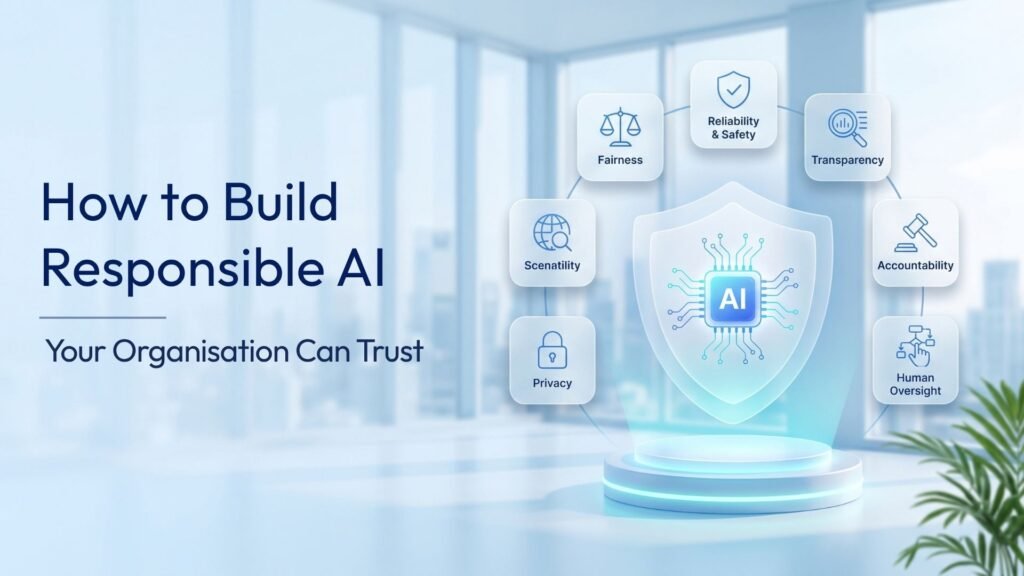
Most organisations no longer ask whether AI belongs in their business. They ask how to build responsible AI that leadership,…