
Dynamics 365 Customer Service is setting a new standard for support. As UK service teams face growing demands, this shift is timely. Customers now expect fast, accurate, and personalised responses across all channels, including live chat, phone, or email at any time.
However, many service teams face a different reality. Recent research shows that 57% of customers have abandoned purchases due to poor support, and 42% admit to being ruder to chatbots than to human agents. This is not only a satisfaction issue but also a revenue concern. Poor customer service costs UK businesses billions each year through lost contracts, reduced loyalty, and avoidable churn.
The tools most service teams are still using were simply not built for the expectations customers have today. Fragmented systems, manual case handling, and reactive support models are holding organisations back, and the gap between what customers expect and what most service functions can deliver is widening.
That is why so many UK organisations are turning to Dynamics 365 Customer Service and embedding AI-powered customer service into the core of how their teams operate. With Microsoft Copilot now deeply integrated across the platform, and four new autonomous AI service agents launched in 2025, the opportunity to transform customer service from a cost centre into a genuine competitive advantage has never been more accessible. Microsoft was also recognised as a Leader in both the Forrester Wave for CRM and the Gartner Magic Quadrant for CRM Customer Engagement Centre in 2025, a further signal that this platform is setting the standard for the industry.
Before diving into the benefits of Dynamics 365 Customer Service, it’s important to acknowledge the existing breakdowns in service functions across the UK. These specific pain points are costing organisations more than most leaders realise.
UK contact centre attrition rates are among the highest in any sector. Agents spend much of their shifts switching between systems, searching for information, and handling the same types of queries repeatedly. This is not because the work is complex, but because the tools fail to support them adequately. When agents cannot perform their best work, they leave. The cost of replacing a trained service agent through recruitment, onboarding, and lost productivity is high.
Most service teams operate with a mix of outdated CRM tools, email threads, spreadsheets, and communication platforms that were not intended to work together. As a result, agents seldom have a complete view of the customer. They make decisions based on incomplete information, forcing customers to repeat themselves with each interaction, which contributes to customer dissatisfaction.
Today’s customers expect to switch seamlessly between channels, starting a query via chat, following up by phone, and receiving updates by email with full continuity along the way. Most service platforms cannot provide this. Each channel operates independently, causing context to be lost between interactions and fragmenting the customer experience at critical moments.
Many service managers still depend on end-of-day reports and weekly reviews to understand what happens on the floor. By the time trends are identified, such as a rise in a certain type of query, consistently missed SLAs, or agents needing coaching support, the chance for proactive intervention has passed. Real-time visibility is essential for service leaders.
Dynamics 365 Customer Service is a cloud-native platform that brings every stage of customer support into a single, AI-driven environment. Built on Microsoft’s latest generative AI, it handles everything from intelligent case management and automated knowledge sharing to smart routing, real-time analytics, and seamless collaboration, all within one unified workspace.
As part of the broader Dynamics 365 ecosystem, it connects natively with Sales, Field Service, and Customer Insights, delivering consistent, joined-up support at scale. For UK organisations looking to modernise their service function without disrupting what is already working, it provides a scalable path forward built on technology they already trust.
In 2025, Microsoft extended the platform further with four dedicated AI service agents, purpose-built autonomous tools that operate across the customer service lifecycle, handling the manual work so service teams can focus on the interactions that require genuine human expertise.
The following capabilities address the specific challenges outlined above. Each one is designed not just to add a feature, but to remove a friction point that is currently slowing service teams down or degrading the customer experience.
If your agents are currently juggling five different applications to resolve a single case, Copilot Service Workspace ends that immediately. Agents handle multiple sessions simultaneously within a single, unified interface, switching contexts without losing information, accessing macros and quick saves to accelerate routine tasks, and receiving AI-generated response suggestions, email drafts, and case summaries in real time.
The impact is direct: average handle times fall, new agents ramp up faster, and tier-two escalations reduce because Copilot surfaces the right answer before the agent needs to escalate. For service managers dealing with high turnover and onboarding costs, this capability alone justifies the investment.
Customers no longer accept being asked to repeat themselves. Dynamics 365 Customer Service solves channel fragmentation by running chat, SMS, digital messaging, email, and a native voice channel through a single AI-powered platform. Every interaction is captured in the same environment, so context is never lost between channels.
Intelligent routing assigns each case to the right agent based on skill set, current workload, and machine-learned predictions about customer needs, not a manual queue. Sentiment-based routing goes further, detecting customer emotion in real time and directing distressed customers to the most experienced agents available. Routing diagnostics give supervisors full transparency over every decision the system makes.
One of the most consistent drains on handle time is agents searching across multiple systems for information they should already have at their fingertips. The AI-driven knowledge base in Dynamics 365 Customer Service automatically surfaces relevant articles and solutions during live cases, before the agent has to go looking.
Federated search extends this further, connecting to both internal databases and trusted external sources. The Customer Knowledge Management Agent, one of Microsoft’s four new AI agents, takes this a step further; it continuously updates knowledge articles based on insights from case notes and resolved interactions, so the knowledge base improves automatically over time without manual intervention from the team.
Escalations are expensive. Every time a case is passed to a specialist or supervisor, handle time increases, customer patience decreases, and agent confidence erodes. Dynamics 365 Customer Service integrates directly with Microsoft Teams, allowing agents to pull in experts for instant, in-context collaboration without leaving the case workspace.
The agent retains full case context throughout. The specialist provides input without needing a full handover. The customer gets a faster resolution. It is a smarter model for connecting knowledge across the organisation, and it significantly reduces the volume of cases that actually need to be escalated.
Supervisors who rely on end-of-day reports are always one step behind. Dynamics 365 Customer Service provides real-time dashboards tracking case volumes, SLA compliance, agent activity, and service entitlements simultaneously. AI-driven topic clustering identifies emerging query trends before they lead to volume spikes, giving supervisors the lead time to proactively adjust staffing and resources.
The platform’s forecast report feature uses historical patterns and predicted case volumes to plan staffing levels in advance, eliminating the reactive scramble that characterises most contact centre workforce planning. For supervisors, this is the difference between managing incidents and preventing them.
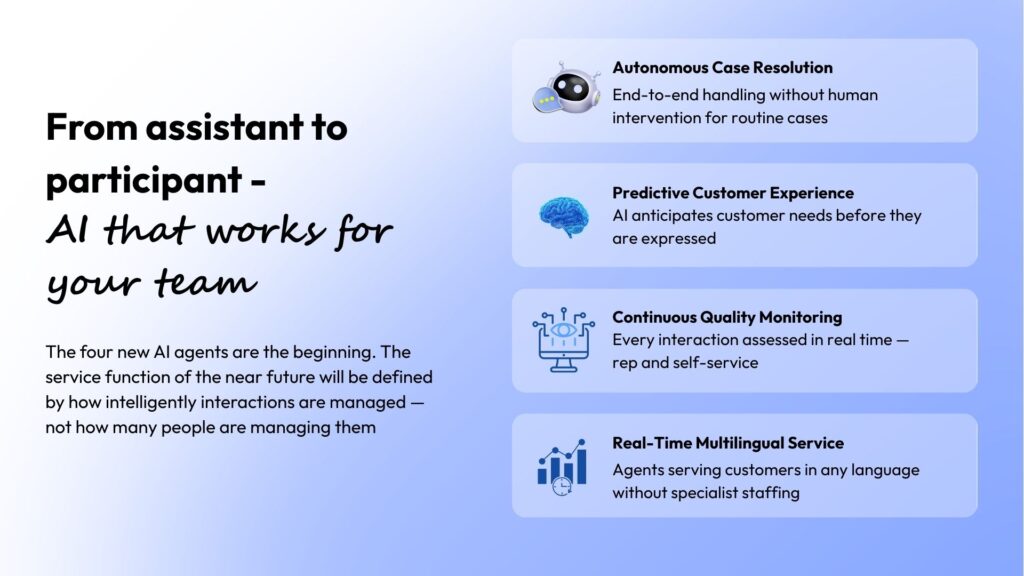
Microsoft’s most significant recent update to Dynamics 365 Customer Service is the introduction of four autonomous AI agents, each designed to handle a specific, high-volume aspect of the service lifecycle independently. These are not Copilot assistants that support human agents. They are autonomous agents that complete end-to-end tasks without human intervention, freeing service teams to focus entirely on complex, relationship-critical interactions.
Automates the full case lifecycle from creation and classification through to resolution and closure, reducing handle time and eliminating the burden of manual case administration from service representatives entirely.
Keeps knowledge articles perpetually current by continuously mining insights from case notes, resolved interactions, and other service artefacts. The knowledge base improves automatically as cases are handled, with no manual curation required.
Enables always-on self-service by discovering and mapping customer intents from conversations across every channel. As new intent patterns emerge, the agent updates self-service flows automatically, keeping automated support relevant without ongoing configuration.
Monitors service quality across every customer interaction from human service representatives through to self-service agents. It identifies coaching opportunities, flags quality issues, and provides supervisors with structured insight into where performance can be improved.
Together, these four agents represent a genuine step change in what is possible for service operations, not AI as a feature add-on, but AI as an active participant in the service function, handling the work that has historically consumed the most time and delivered the least strategic value.
The right tools change not just how teams operate, but how they feel about the work they do. Here is how Dynamics 365 Customer Service delivers measurable impact across the service function:
Copilot-assisted case handling, intelligent routing, and automated knowledge surfacing combine to cut average handle time significantly. Lenovo, for example, reduced handling time by 20% using Copilot in Dynamics 365, a result that scales directly to cost savings and customer satisfaction improvements.
Automated case administration, touchless documentation, and AI-generated summaries remove the repetitive, low-value tasks that drive agent burnout. Agents spend more time on meaningful interactions and less time on administration, which directly improves both satisfaction and retention.
Skills-based routing, sentiment detection, and real-time knowledge recommendations ensure the right agent handles the right case with the right information from the first interaction. Hype achieved a 90% first call resolution rate using Dynamics 365, a benchmark that reflects what the platform makes possible at scale.
Real-time dashboards, AI-driven topic clustering, and predictive staffing tools give service leaders the visibility to act before problems escalate, not after they have already affected customers and SLAs.
Customers move between channels without losing context. VIVID saw a 72% increase in digital channel engagement after deploying Dynamics 365 Customer Service, driven by the consistency and quality of experience the platform makes possible across every touchpoint.
Beyond the four new AI agents, Microsoft has continued to strengthen Dynamics 365 Customer Service across the board. Key recent updates include:
Copilot upgrades across the workspace: faster suggestions, deeper in-context knowledge article surfacing, and real-time insights embedded directly within live conversations.
Automated case summaries: Copilot now generates comprehensive case summaries automatically, keeping every team member informed without manual effort across multi-session and multi-agent interactions.
Unified Customer Service admin centre: A single dashboard brings configuration, reporting, and management tools together for IT teams and supervisors, reducing the administrative burden of platform management.
Copilot Studio integration: New capabilities for building custom AI workflows and knowledge automation, giving organisations the flexibility to configure Copilot behaviour to their specific service processes and industry requirements.
Generative AI-powered IVR: Conversational interactive voice response that resolves customer issues through natural, human-like interactions without requiring agent intervention for routine queries.
Real-time translation: Agents can now communicate with customers in their chosen language in real time, expanding service reach without requiring multilingual staffing.
More than 1,000 prebuilt Power Automate flows: Eliminating manual processes and enabling custom data connector integrations across the wider technology ecosystem.
Consider a UK-based professional services organisation managing customer support across multiple service lines, regions, and communication channels. Before deploying Dynamics 365 Customer Service, the team was operating across a mix of legacy CRM tools and email-based case management. Agents manually searched knowledge bases, routing was inconsistent, supervisors had no real-time visibility, and the month-end service report was the first indication that something had gone wrong weeks earlier.
Following implementation, the picture changed structurally. Copilot-assisted case handling reduced average resolution times. Intelligent routing ensured the right agent handled every case from the outset. The Case Management Agent took over end-to-end case administration for routine query types, freeing experienced agents entirely for complex interactions. Supervisor dashboards provided live insight into workload distribution, emerging query trends, and SLA status, without waiting for a report.
More significantly, agent satisfaction improved alongside customer satisfaction. When people are given tools that support them rather than frustrate them, the quality of the customer interaction improves naturally. That is what Dynamics 365 Customer Service makes possible, and it is a consistent pattern across the organisations that have committed to the platform.
For NHS trusts and healthcare providers, the implications are equally direct. Patient-facing service teams handling appointment queries, referral management, and administrative support can use the same platform to unify communication channels, reduce call handling times, and ensure frontline staff always have access to accurate, current information, without adding to the burden on clinical teams who cannot afford additional administrative complexity.
The direction of travel is clear. AI in customer service is moving rapidly from assistant to participant, from a tool that helps agents work faster to a system that handles entire categories of work autonomously, escalating only when genuine human judgement is required.
The four AI agents Microsoft launched in 2025 are the beginning of that shift, not the end of it. The roadmap points towards service environments where the majority of routine interactions are handled end-to-end by AI, customer intent is understood before a query is even submitted, and quality monitoring operates continuously across every channel without requiring supervisor review of individual interactions.
For UK organisations, the competitive implication is straightforward. Service functions that invest in AI-driven platforms now will build structural advantages in efficiency, quality, and customer retention that will be increasingly difficult for late adopters to close. The cost of waiting, in lost customers, agent turnover, and widening capability gaps, compounds every quarter that action is deferred.
Understanding what Dynamics 365 Customer Service can do and successfully deploying it to deliver measurable outcomes for your organisation are two different things. The gap between the two is where implementation expertise, sector knowledge, and ongoing partnership make the difference.
Mazik Global UK works with service leaders across healthcare, professional services, and non-profit organisations to design, implement, and sustain Dynamics 365 Customer Service environments that are built around the specific realities of their teams, not a generic deployment applied from a template.
Before any implementation begins, Mazik works with service leadership to understand where the real friction points are. Which interactions are consuming the most agent time? Where are SLAs being missed and why? What does the current routing logic look like, and where is it breaking down? This structured assessment shapes an implementation that solves actual problems rather than deploying features for their own sake, and it ensures the business case is built on outcomes, not assumptions.
A platform no one uses delivers no value. Mazik’s implementation approach is built around adoption from day one, with change management frameworks, role-specific training programmes, and quick-start configurations that get agents productive on Dynamics 365 Customer Service as quickly as possible. For service teams already under pressure, minimising disruption during transition is not optional. It is the difference between a successful deployment and one that stalls.
Getting Copilot and the four new AI agents working effectively requires more than switching them on. Mazik configures Copilot behaviour to reflect your organisation’s specific knowledge base, routing logic, and quality standards. AI agent deployment is phased and validated, ensuring each agent is performing accurately before expanding its scope. For organisations in regulated sectors, this governance layer is essential.
Mazik’s experience spans NHS trusts, non-profit organisations, and professional services firms — sectors where service quality has consequences beyond customer satisfaction scores. Understanding the specific compliance requirements, data governance obligations, and operational constraints that apply in these environments means implementations are right the first time, not retrofitted for compliance after go-live.
The platform will continue to evolve. Microsoft’s release cadence for Dynamics 365 Customer Service is consistent and substantial; new Copilot capabilities, agent updates, and platform enhancements arrive regularly. Mazik’s managed service model ensures your organisation stays current, with regular health checks, proactive planning, and priority access to new capability assessment. You are always operating at the leading edge, not catching up with it.
Customer service is no longer a function to be managed and minimised. In a market where product differentiation is narrowing, and customer expectations are rising, the quality of the service experience is increasingly the factor that determines whether a customer stays or leaves, recommends or criticises, renews or walks away.
Dynamics 365 Customer Service, now with four autonomous AI agents, deeper Copilot integration, and recognition from both Forrester and Gartner as the leading CRM platform, gives UK service teams the tools to move beyond reactive, fragmented support towards proactive, connected, and genuinely personalised customer experiences at scale.
Organisations that make that investment now will build service functions that are faster, more consistent, and structurally better positioned to retain the customers they have worked hard to win. Mazik Global UK is the Microsoft partner that helps UK organisations make that transition, with the expertise, the sector knowledge, and the ongoing commitment to ensure the technology delivers what it promises.
Speak with our Dynamics 365 specialists today. We will help you identify where AI-driven customer service can have the greatest impact in your organisation and build a clear path to getting there.
Introduction Dynamics 365 Customer Service is setting a new standard for support. As UK service teams face growing demands, this…
Introduction Finance leaders across the UK are navigating a rapidly shifting landscape. Rising operational costs, increasing regulatory complexity, and growing…
Mazik Global UK has successfully achieved NHS DSPT certification UK status for 2025–26, reinforcing our commitment to maintaining the highest…