HR is under real pressure to deliver efficiency at scale. McKinsey reports that up to 30% of current working hours may be automated by 2030, and HR functions are first in line for transformation. Recruiting, onboarding, and engagement cycles are too important and too resource-intensive to leave manual.
In the UK, it takes an average of 42 days to fill a Vacant Position. Every day beyond that cost’s productivity, disrupts team delivery, and puts pressure on the people left covering the gap. For HR teams already managing onboarding, benefits, compliance, and performance cycles, the manual effort behind each of these processes is the problem. The question is no longer whether to automate HR. It is how quickly organisations can do it without losing the human connection that makes HR effective.
Dynamics 365 Human Resources answers. With a connected suite of capabilities spanning the full hire-to-retire lifecycle, and a growing layer of Copilot and agent-driven intelligence being added across the 2025 and 2026 release waves, organisations can now automate HR processes with Dynamics 365 in ways that were simply not possible twelve months ago.
This blog covers what Dynamics 365 Human Resources already delivers, what has shipped across the 2025 Wave 1 and Wave 2 releases, and what is arriving between April and September 2026, giving HR leaders a complete picture of where the platform is now and where it is heading.
Before you can truly transform HR with AI and Copilot features, you need a strong operational base. Dynamics 365 Human Resources delivers this foundation with a full suite of features designed to reduce manual workload, connect systems, and prepare HR teams for intelligent automation.
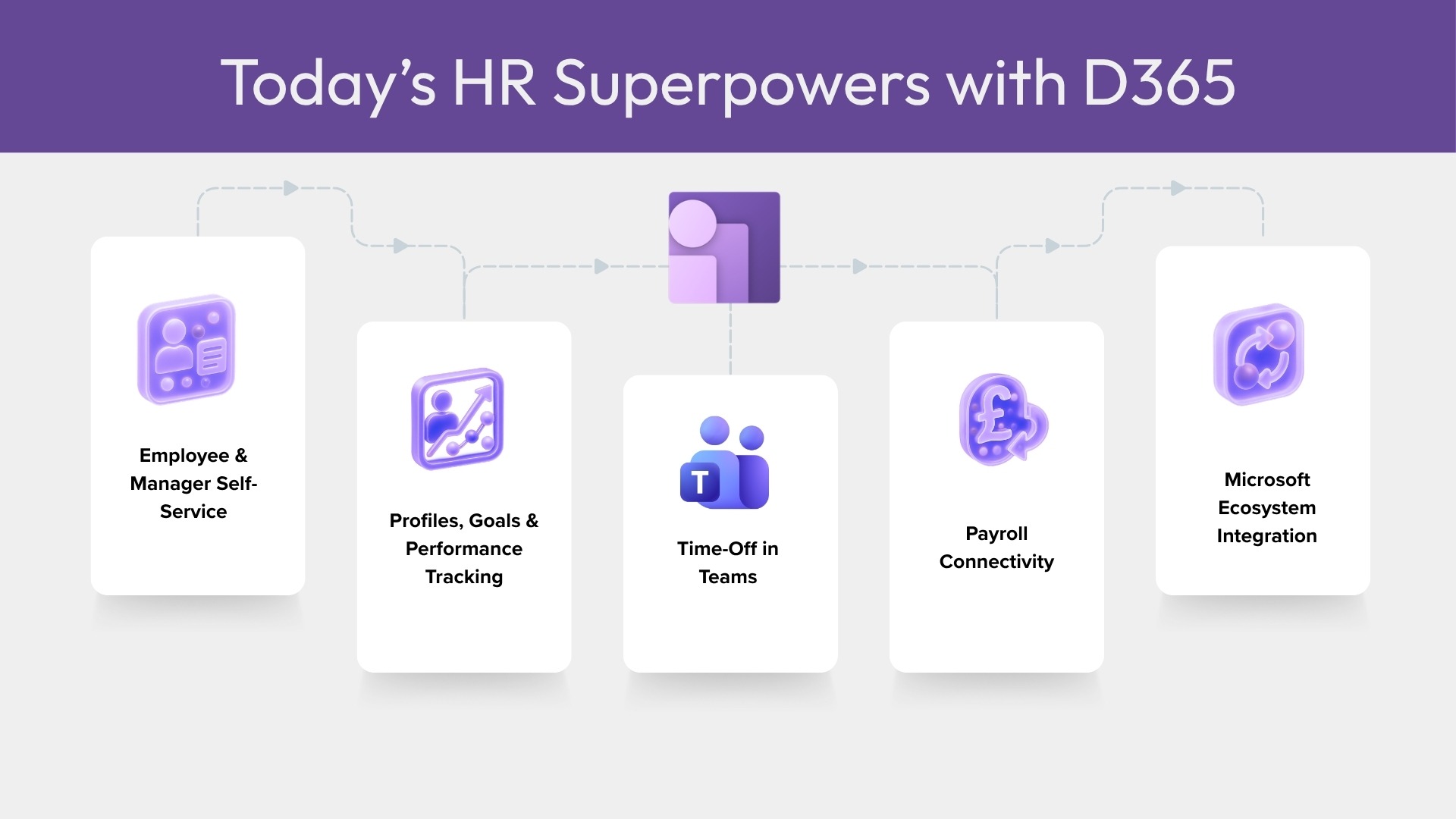
Here is what it offers:
One of the most valuable elements of Dynamics 365 Human Resources is its self-service capability. Employees can update their personal information, view payslips, request time off, and check benefit enrolments without opening a ticket or emailing HR. Managers get a single view to approve requests, review team data, and track performance metrics.
As a result, there is a dramatic reduction in admin overhead, improved data accuracy, and greater employee ownership of their information, all of which set the stage for automation to deliver even more value.
Beyond basic record-keeping, Dynamics 365 Human Resources supports structured goal setting and performance management. HR teams can define job roles and success metrics, while employees update progress in real time. Managers gain visibility into alignment between individual goals and wider organisational aims.
This supports continuous performance cycles rather than annual reviews only and underpins Dynamics 365 talent management strategies by making engagement and development measurable and actionable, not just paperwork exercises.
Leave management becomes far more efficient with Dynamics 365 HR features embedded directly into Microsoft Teams. Employees can submit time-off requests and see their remaining balance without leaving their collaboration hub, and managers can approve or reject requests from the same interface.
Business rules, such as carry-over limits or eligibility criteria, are applied automatically. These help with compliance without manual intervention. Since this functionality is surfaced in Teams, there is no need for employees to switch between multiple applications.
Now generally available as of June 2025, this Wave 1 2025 feature allows compensation plans to be tied directly to positions rather than only to individuals. This is a meaningful change for organisations with complex pay structures, enabling more precise compensation management and reducing the manual adjustments needed when roles change or headcount shifts.
Also generally available from June 2025, this Wave 1 2025 capability reduces the manual work involved in determining and updating employee benefit eligibility. What was previously a time-consuming administrative process, particularly during onboarding and life events, is now significantly more automated, reducing errors and freeing HR teams to focus on higher-value activities.
While Dynamics 365 Human Resources does not include built-in payroll processing for every region, it integrates seamlessly through Dynamics 365 Finance and Operations (F&O) with specialised payroll solutions such as Dayforce.
In this configuration, D365 F&O manages the financial and payroll data framework, while D365 HR serves as the core hub for employee information, approvals, and HR policies. The Dayforce payroll system then manages calculations, payments, deductions, and statutory compliance. Everything is synchronised through connected data flows between the three systems.
This structure follows a unified process, i.e., D365 F&O > D365 HR > Dayforce.
Finally, Dynamics 365 HR features are not standalone. They benefit from deep integration with the broader Microsoft ecosystem. LinkedIn Talent Solutions connects candidate data and sourcing directly into recruitment workflows.
Teams becomes the natural front-end for time-off requests, approvals, and HR notifications. Power Automate can extend workflows even further, and the Power Platform can host custom HR apps without expensive development projects. This connected approach ensures HR technology does not sit in a silo but becomes part of the enterprise-wide digital workplace.
AI and Automation Capabilities Now Live in Dynamics 365 HR
Even with current Dynamics 365 HR features, most HR teams still spend too much time drafting job ads, manually tracking onboarding checklists, and chasing data across systems.
The 2025 Wave 2 release (October 2025 to March 2026) introduced a significant set of Copilot and agent capabilities into Dynamics 365 Human Resources. These features are now live or reaching general availability imminently. HR teams that are not yet using them are leaving measurable efficiency on the table.
Here is what’s coming:
Recruiter Assist is the branded AI agent within Dynamics 365 HR for recruitment workflows. Recruiters can generate job descriptions directly within the platform using Copilot, pulling from organisational data and role templates to create a first draft that can be refined rather than written from scratch. The same agent provides structured interview assistance — guided question sets and scoring frameworks that improve consistency across hiring decisions. Both capabilities reduce time-to-post and bring greater fairness to the recruitment process, representing a significant step forward for Microsoft Dynamics 365 for recruitment.
Building on Recruiter Assist, agent-assisted candidate assessment helps recruiters shortlist applicants quickly and fairly. The feature uses existing HR data and applicant tracking information to generate ranked recommendations and interview evaluation prompts. It supports AI for talent acquisition in an auditable way, with bias monitoring built into the governance framework. This means organisations can move faster on hiring decisions without sacrificing fairness or compliance.
Separate from Recruiter Assist, the Job Craft Agent is a versatile tool within Microsoft Copilot Studio that streamlines job description creation, interview preparation, and the specification of role requirements. Organisations can use it to generate job descriptions and interview questions from natural language input and can customise the agent’s behaviour to reflect their own organisational language and role frameworks a flexible, low-code tool for managing job content at scale.
The onboarding process becomes far more consistent with a guided onboarding agent that manages document collection, policy acknowledgements, and training tasks across systems, surfacing them directly in Microsoft Teams. New hires are walked through a structured sequence of steps with Copilot managing the flow and sending automated reminders for outstanding items. This is one of the clearest examples of streamlining HR workflows with AI, reducing missed steps and manual follow-ups while giving HR teams clear visibility into onboarding progress.
The Wellness Check Agent assists employees in incorporating healthy habits into their working day through Microsoft Teams. It delivers tailored recommendations on wellness activities, including breathing exercises, journaling prompts, and reminders to take regular breaks. For organisations prioritising AI in employee engagement, this agent places wellbeing support directly in the flow of work without requiring employees to use a separate wellbeing platform.
Integration with Microsoft Viva Connections brings HR dashboards, adaptive cards, and relevant links into employees’ daily collaboration hub in Teams. Because employees encounter HR information and actions where they are already working, adoption improves, and the HR team fields fewer routine queries. This is particularly powerful for organisations looking to improve AI in employee engagement by removing the friction of navigating multiple systems.
This feature aligns employee identities with Microsoft Entra ID, ensuring consistent authentication and access control across all connected systems. This improves the security posture, simplifies single sign-on, maintains data integrity, and is a critical step when deploying HR automation tools that expose sensitive employee data through Copilot and onboarding agents.
Available in public preview from October 2025 and reaching general availability in March 2026, this Wave 2 2025 feature allows HR administrators to formally retire outdated job codes and titles. Keeping job libraries current has historically been a persistent administrative burden. This capability addresses it cleanly, improving data quality and reducing noise that can affect reporting, compensation benchmarking, and role-based access controls.
Published on 18 March 2026, the 2026 Wave 1 release plan signals a clear continuation of Microsoft’s investment in agentic HR. Rather than introducing isolated new features, Wave 1 2026 builds on the foundations laid in 2025 and pushes Dynamics 365 Human Resources further into intelligent, autonomous workflow management. Features will roll out directly into General Availability from 1 April 2026, with UK deployment scheduled between 3 and 6 April 2026. You can track the full timeline on the Microsoft release plans page.
→ Recruitment enhancements: Further Copilot-assisted recruiting capabilities building on Recruiter Assist, with deeper integration between candidate data, role requirements, and hiring workflows.
→ Onboarding improvements: Expanded onboarding agent, new hires receive key URLs immediately, are guided through personal detail confirmation, can upload ID documents via OCR verification, and receive Copilot assistance drafting an introductory email to their new team.
→ Expanded regional payroll integrations: new payroll partnerships beyond Dayforce, broadening the range of supported payroll providers; directly relevant for UK and international organisations with complex payroll requirements.
→ Workforce management and reporting: Improved reporting and analytics across the HR function, giving HR leaders cleaner data and faster access to workforce insights.
→ Immersive Home General Availability: A modern, AI-driven workspace experience designed to help Dynamics 365 users stay focused and prioritise what matters most, rolling out across Finance and Operations apps, including HR.
→ MCP Server improvements: Model Context Protocol enhancements strengthen the foundation for AI agent connectivity across Dynamics 365, allowing agents to draw on richer organisational context when supporting HR tasks.
“2026 release wave 1 updates for Dynamics 365 deliver AI-powered, agentic experiences across HR, bringing deeper Copilot integration, intelligent automation, and enhanced cross-app capabilities to help organisations drive efficiency and elevate employee experiences.”
— Microsoft Dynamics 365 Blog, March 2026
The direction is unmistakable. Microsoft is not adding AI as a layer on top of Dynamics 365 Human Resources. It is rebuilding how the platform works around intelligent agents that act, orchestrate, and learn with human oversight built in by design. You can read the full announcement on the Microsoft Dynamics 365 Blog.
Implementing Dynamics 365 Human Resources is just the starting point; the real challenge is getting every feature, workflow, and AI capability to deliver measurable results.
For that, Mazik Global is the best choice. We help organisations bridge the gap between technological potential and real HR impact.
Here is how:
Mazik configures Dynamics 365 HR to turn performance reviews into a simple, goal-driven process. Instead of chasing forms and spreadsheets, managers and employees focus on real progress and meaningful feedback. Data updates automatically in reports, so HR can spot trends quickly and act on them before issues build up.
Rolling out Copilot and agent features works best when your system is healthy and continuously monitored. The Mazik Dynamics Program keeps Dynamics 365 Human Resources running smoothly with ongoing health checks, error detection, and performance optimisation. You get clear visibility into adoption, with metrics showing whether your efforts to streamline HR workflows with AI are landing with managers and employees. Mazik provides coaching on feature enablement and change management, so your HR team knows how to configure and use each tool.
Your systems should stay online and secure to enable AI-powered HR processes. Mazik Global’s Microsoft-certified support services keep Dynamics 365 HR features available and dependable, with faster issue resolution backed by SLAs.
Our managed IT security services tighten identity and access controls, which is critical when exposing sensitive employee data to Copilot and onboarding agents. This approach reduces risk and helps you stay compliant while you automate HR processes with Dynamics 365.
Implementing AI for talent acquisition or Copilot-driven onboarding needs careful setup and ongoing tuning. Mazik Global’s Managed AI Service provides that backbone, from prompt engineering and AI model tuning to governance frameworks and initiative-taking monitoring of results.
This ensures that job ad generation, candidate assessment, and onboarding agents are accurate, fair, and aligned with compliance standards.
Technology adoption is where many HR automation projects succeed or fail. We help embed HR tasks directly into Microsoft Teams and Viva Connections, so employees find them in the flow of work instead of chasing multiple systems.
Mazik Global also runs training and adoption programmes to build confidence to help you use the full value of the HR automation tools Microsoft delivers.
Microsoft brings a new layer of intelligence to HR, but it only delivers results if the groundwork is in place. Here is how you can prepare your organisation:
Technical Readiness: Configure Microsoft Entra ID for clean, consistent identities across all connected systems. Check licensing requirements. There is an important distinction between full HR licences and self-service licences. Confirm regional availability for the specific features you plan to enable, and test integrations with payroll providers, LinkedIn, Teams, and Power Platform before go-live.
Process Re-Engineering: Audit your existing HR workflows to identify where bottlenecks exist and where Copilot and agents can add the most value. Assign clear owners for configuration, monitoring, and day-to-day administration of each automated process.
Training & Change Management: Give HR teams and managers hands-on training with Recruiter Assist, the Job Craft Agent, candidate assessment tools, and the onboarding agent. Adoption does not happen automatically; it requires deliberate enablement and ongoing reinforcement.
Data & Governance: Review privacy policies, access controls, and compliance requirements. Plan for bias monitoring in candidate assessment workflows and document clearly how AI recommendations will be used, reviewed, and overridden where necessary. As Wave 1 2026 brings MCP server improvements and richer agent connectivity, strong data governance becomes even more critical.
Dynamics 365 Human Resources is far more than a system of record. With the AI and agent capabilities now live across the 2025 wave releases, and the expanded onboarding, recruitment, payroll, and workspace features arriving in Wave 1 2026, it is becoming a platform for intelligent decision-making and continuous employee engagement.
The organisations that prepare now, building the right data foundations, enabling the right features, and investing in adoption, will be the first to capture the compounding benefits of AI in human resource management. Those who wait will find themselves managing the gap between where their people expect HR to be and where their systems actually are.
Mazik Global works with UK organisations across professional services, healthcare, and the not-for-profit sector to make this transition practical, sustainable, and measurable. If you would like to explore what AI-driven HR looks like for your organisation, speak with our team today.
HR is under real pressure to deliver efficiency at scale. McKinsey reports that up to 30% of current working hours…
Over the past few years, we have seen AI move from experimental to practical. What once felt like a future…
Introduction Dynamics 365 Customer Service is setting a new standard for support. As UK service teams face growing demands, this…