
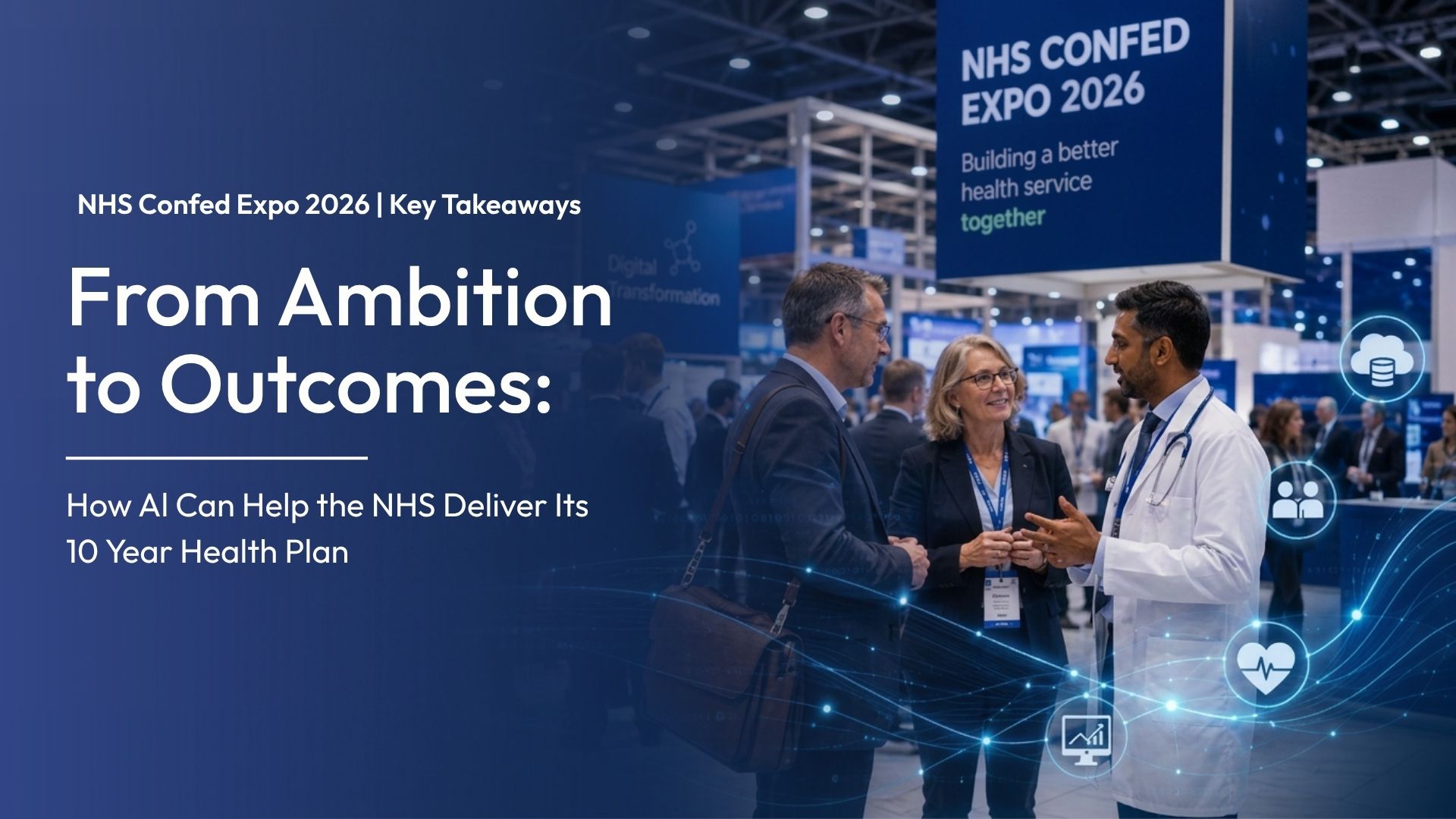
After two days at NHS Confed Expo 2026, one message came through louder than any other:
The NHS knows what it needs to do. The challenge is how it delivers – at pace, at scale and under relentless pressure.
The conversations were about:
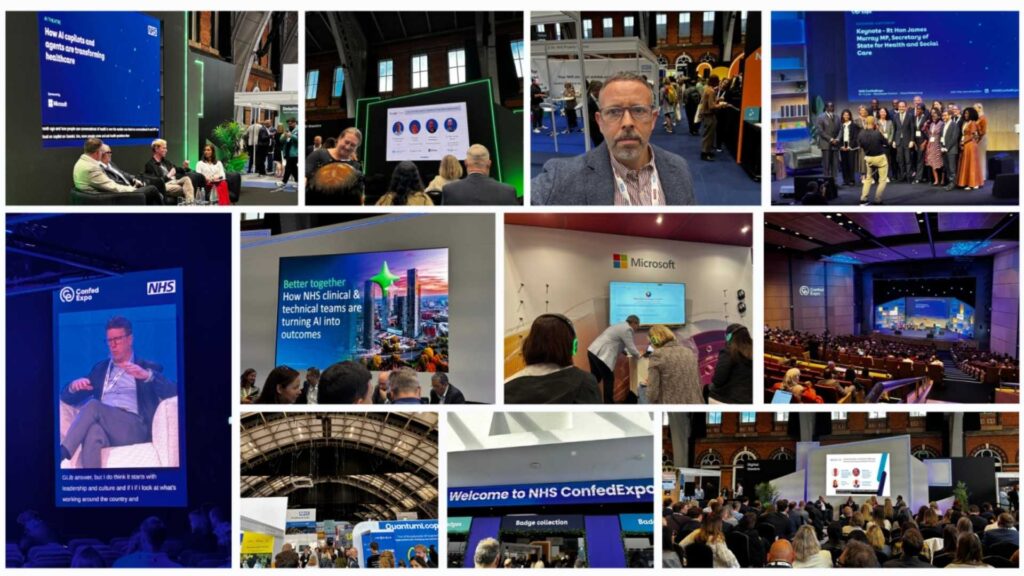
Despite genuine progress over the past year, including reductions in waiting lists and improvements in elective performance, the NHS continues to operate under extraordinary pressure.
Demand is rising, the population is ageing, mental health needs are growing, workforce shortages remain acute, financial headroom is minimal… and unlikely to improve. The real question facing NHS leaders is no longer: “How do we spend more?” but instead: “How do we deliver better outcomes with the resources we already have?”
This tension sits at the very heart of the NHS 10 Year Health Plan.
Across both days, one issue kept resurfacing: fragmented data.
Patient information sits in silos:
These systems rarely communicate effectively with each other.
The consequences are well known:
Many speakers were blunt: AI is only as good as the data it can access. Without interoperability, governance, and trusted data foundations, AI cannot deliver meaningful value.
Another consistent message was the rejection of the idea that AI exists to replace healthcare professionals. Healthcare is, and will remain, deeply human. Patients want empathy, reassurance and trusted relationships with clinicians. Where AI can make a difference is by removing the growing administrative burden that prevents clinicians from spending time with patients.
One striking statistic discussed at Confed suggested that for every hour of patient care, clinicians may spend several additional hours on administration – documentation, data entry, searching for information and managing referrals.
A major area of interest at the conference was Agentic AI. Rather than simply answering questions or generating content, Agentic AI can orchestrate workflows, coordinate tasks and automate handoffs across systems.
Crucially, this does not require ripping out existing technology. Instead, AI can sit across the current estate and help organisations reorganise workflows around what they already have. This represents an important shift – from replacing systems to extracting more value from them. The real question becomes: “If we were designing this service today, how would it work?” not: “How do we automate a broken process?”
Several sessions explored why AI initiatives struggle to move beyond pilots, and the reasons were strikingly consistent. Many organisations face challenges with poor data quality, weak governance structures, and unclear ownership of AI initiatives. As a result, many organisations are now stuck in what was described as a “pilot frenzy”, where experimentation is widespread but meaningful scale remains elusive. Pilots are relatively easy to initiate, but scaling them across complex healthcare environments is significantly more difficult.
The key lesson emerging from these discussions is the importance of starting with a clearly defined problem, agreeing on measurable outcomes from the outset, and proving value before attempting to scale. Ultimately, technology alone is rarely the deciding factor in success; it is people, culture, and leadership that determine whether AI delivers real impact.
Patient experience featured heavily in discussions, particularly the ambition for the NHS App to become the front door to healthcare. Patients increasingly expect visibility, updates, self-service, and digital-first interactions. Many frustrations are not about waiting itself but about not knowing where my referral is, what happens next, and who do I contact.
AI-powered patient engagement, intelligent communications and digital assistants have real potential to improve this experience if implemented as part of a broader service redesign.
The NHS has no shortage of ambition; the challenge is execution. The themes from NHS Confed align closely with the 10 Year Health Plan:
AI can support all of these, but only if the foundations are right:
Without these, AI remains potential and, with them, it becomes transformative.
At Mazik Global, the challenges discussed at NHS Confed are the same challenges we help healthcare organisations address every day.
We help NHS organisations:
The conversations at Confed reinforced a belief we’ve held for years about healthcare transformation not being about implementing more systems but about creating better experiences for patients, better working environments for staff and more sustainable models of care.
Let’s speak? Drop us a message or contact us directly Mazik Global UK.
Businesses have rarely faced a more demanding operating environment. Supply chain disruption, shifting trade conditions, and persistent cost pressure now…

There is a good chance your charity is already paying for a CRM. Or, more accurately, getting one for free.…

Summary: Assisted living providers are facing rising operational complexity, from workforce pressures and compliance demands to fragmented systems and limited…