
There is a reasonable argument that businesses have never faced a more complex operating environment. Supply chain unpredictability, shifting trade conditions, inflation, and the accelerating pace of AI adoption are all arriving at once. The question most finance directors and operations leaders are sitting with is not whether to modernise their ERP systems. It is how quickly they can do it and what the modernised version should look like.
The answer Microsoft and its partners are pointing to is Agentic ERP. Not a standard cloud ERP upgrade, but a platform where AI agents work alongside your finance and operations teams, managing routine tasks, surfacing risks, and enabling faster decisions at a scale that human effort alone cannot match.
85% of UK finance teams are currently using AI-based applications, significantly ahead of North America at 71%, with 99% of UK finance leaders agreeing that AI is now essential to the finance function. The shift is already underway. What separates the organisations pulling ahead is not just that they have adopted AI. It is that they have begun embedding it into the core processes where it can genuinely change outcomes.
This blog explains agentic ERP in practice, how Microsoft Dynamics 365 delivers it, and why the businesses investing in this now are positioning themselves well for what comes next.
ERP systems were built to record and report. They capture transactions, maintain ledgers, and produce outputs that humans then act on. That model worked well enough in a slower world. In the current environment, it creates a real bottleneck.
Finance teams spend generous portions of their week reconciling data, chasing approvals, and manually building reports that are already slightly out of date by the time they land. Operations teams deal with fragmented processes, disconnected systems, and supplier communications that depend entirely on individual attention and follow-through. The result is predictable: a slow period closes, reactive decision-making, and a workforce that spends more time on coordination than on the work that moves the business forward.
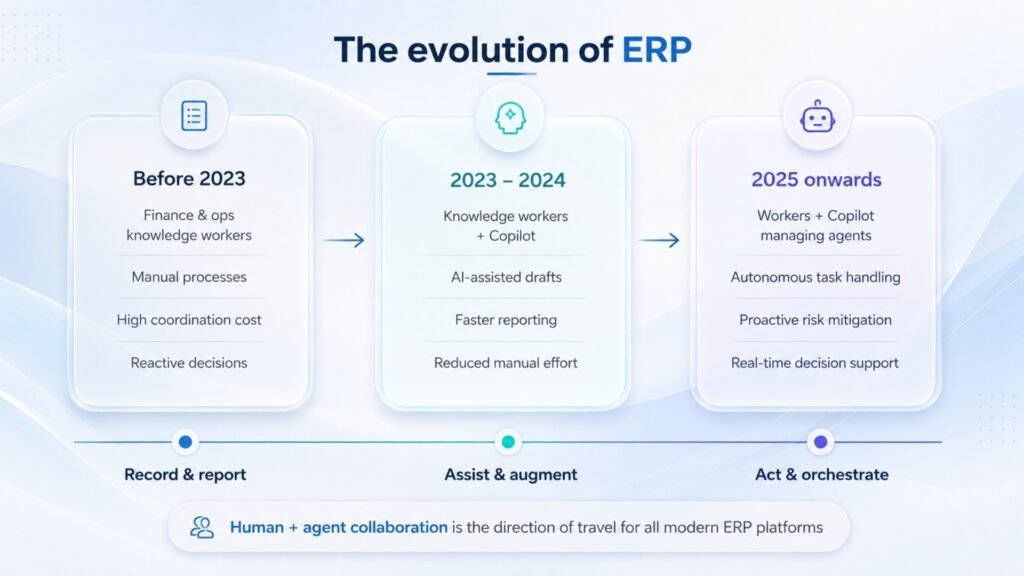
Agentic ERP refers to an enterprise resource planning system in which AI agents are built into core business processes rather than as a separate tool. These agents can observe conditions, reason about what needs to happen, and act or surface recommendations without waiting for a human to initiate the process.
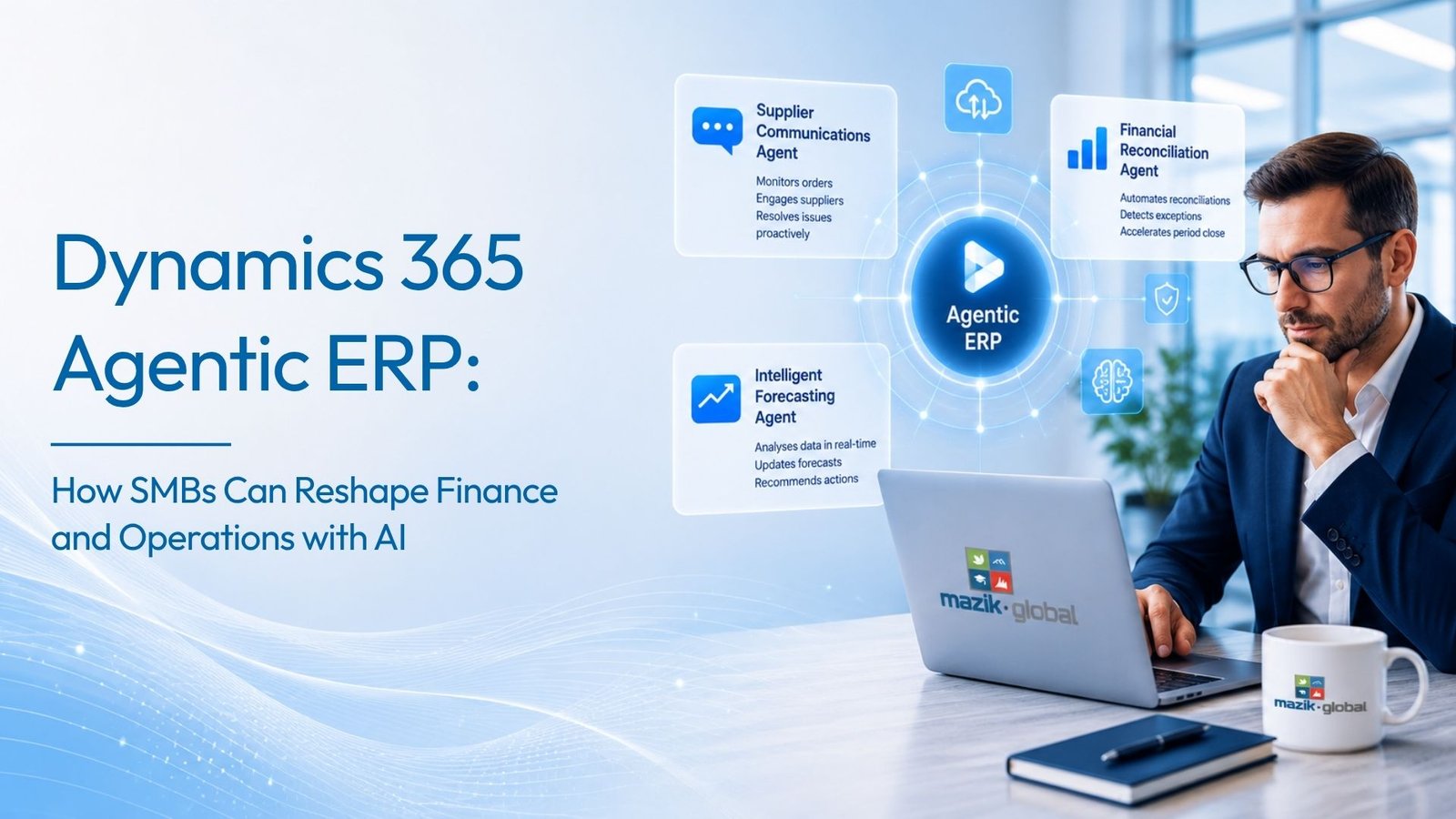
In practical terms, this looks like a supplier communications agent that monitors open purchase orders, detects a potential delay, and contacts the supplier directly to resolve it. Or a financial reconciliation agent that works through bank reconciliation tasks overnight, flagging only the exceptions that genuinely need human review. Or a forecasting agent that continuously updates demand signals and adjusts planning recommendations as conditions change.
The human team does not disappear. What changes is where human attention is going. Instead of spending time on the mechanics of a process, finance and operations professionals shift towards reviewing, interpreting, and acting on the outputs the agents produce. The volume of work the team can manage without growing headcount increases substantially.
66% of UK enterprises are already experiencing significant AI-driven productivity improvements, with 63% of senior leaders citing increased operational efficiency. Senior leaders report that AI and automation are freeing up time for high-impact work, including strategic decision-making, client relationships, and innovation.
Microsoft Dynamics 365 is the platform through which this model becomes real for UK businesses. It spans the full range of finance and operations functions: fiscal management, supply chain, project operations, human resources, commerce, and field service. The agents Microsoft has built into the platform target the processes where autonomous action creates the most value.
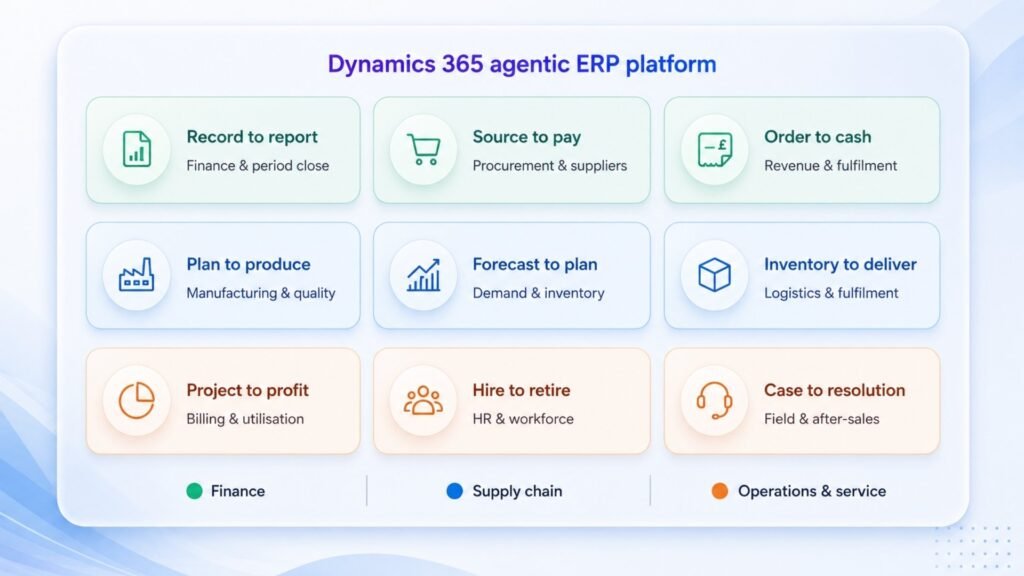
The following three areas of the platform represent the highest-impact starting points for most mid-market and enterprise businesses.
Traditional procurement in an ERP system is reactive. A purchase order is raised, submitted to a supplier, and then managed through a combination of email threads, manual status checks, and exception handling that falls on whoever happens to be paying attention.
The Supplier Communications Agent in Dynamics 365 changes this. It monitors open orders, detects signals of potential delays, and reaches out to suppliers directly to resolve issues before they disrupt the business. When a purchase order needs to be changed, the agent manages the communication and updates autonomously, routing only the cases that genuinely require human sign-off.
For procurement teams dealing with ongoing supplier uncertainty, this kind of proactive, autonomous management is not a nice-to-have. It is a meaningful competitive advantage.
The month-end close is one of the most resource-intensive processes in any finance team. It typically involves large volumes of manual reconciliation, multiple rounds of review, and considerable time pressure. The room for error is high, and the opportunity cost of senior finance professionals tied up in reconciliation work is considerable.
Dynamics 365 brings this to life through pre-built agents designed specifically for financial reconciliation and period close. Bank reconciliation, transaction matching, discrepancy identification, and flagging items for human review are all tasks the agent manages automatically. For finance teams under pressure to deliver accurate management accounts quickly affects the quality of decisions made at the board and leadership levels.
Professional services firms and project-based businesses in the UK face a persistent challenge: billable time and expenses that are captured late, incorrectly, or not at all. The cost of this revenue leakage is rarely visible in a single transaction but adds up significantly over a fiscal year.
The agents in the project operations module of Dynamics 365 address this by automating time and expense capture, accelerating invoice processing, and flagging approval bottlenecks before they delay billing. The result is faster, more accurate invoicing and a meaningful reduction in the gap between work done and revenue recognised.
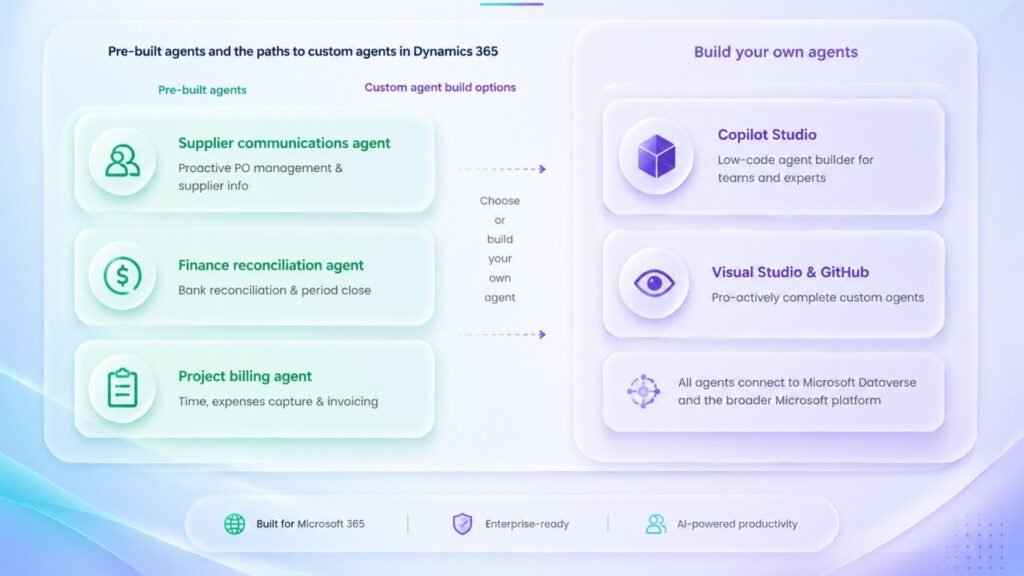
One of the decisions organisations face early in an agentic ERP journey is whether to start with the pre-built agents Microsoft provides or to build custom agents from the ground up. In most cases, the sensible approach is to start with pre-built agents, understand what they deliver in your specific environment, and then extend or build custom agents for the processes that are genuinely unique to your business.
Microsoft has made this accessible across the full range of technical capability. Copilot Studio provides a low-code environment where business analysts and operations teams can configure and extend agents without deep development expertise. Visual Studio and GitHub are available for developer teams building more complex, bespoke agents that integrate with external systems or reflect proprietary business logic.
The platform is Microsoft Dataverse, which means agents across the CRM, ERP, and service layers share a common data foundation. It can operate across process boundaries without requiring custom integration work.
One of the reasons organisations end up with a fragmented ERP landscape is that they solve individual problems with individual tools. 11 or 16 separate ERP systems across a business is not unusual for organisations that have grown through acquisition. The consolidation work is significant, but the cost of not doing it compounds every year.
Dynamics 365 is designed to serve as the consolidation point. It runs on Microsoft Azure, integrates natively with Microsoft 365, Power Platform, and Microsoft Fabric, and connects to third-party applications through a broad AppSource ecosystem. The agents built on the platform operate across these connections, which means a supplier risk signal that surfaces in the ERP can trigger a response that touches procurement, finance, and the relevant account relationship without a manual handoff at each stage.
68% of organisations using AI report productivity gains, and 72% expect AI to increase their ability to grow in the coming year. However, only 24% of adopters have reached the advanced stage where AI forms part of core business processes and decision-making, and the gap between basic and advanced AI adoption is estimated to represent an additional £35 billion in potential economic growth for the UK by 2030.
The distinction between basic AI and advanced AI adoption is precisely the distinction between a tool that helps individuals work faster and a platform where AI is reshaping how the business itself operates. Agentic ERP, built on a connected platform, sits firmly in the second category.
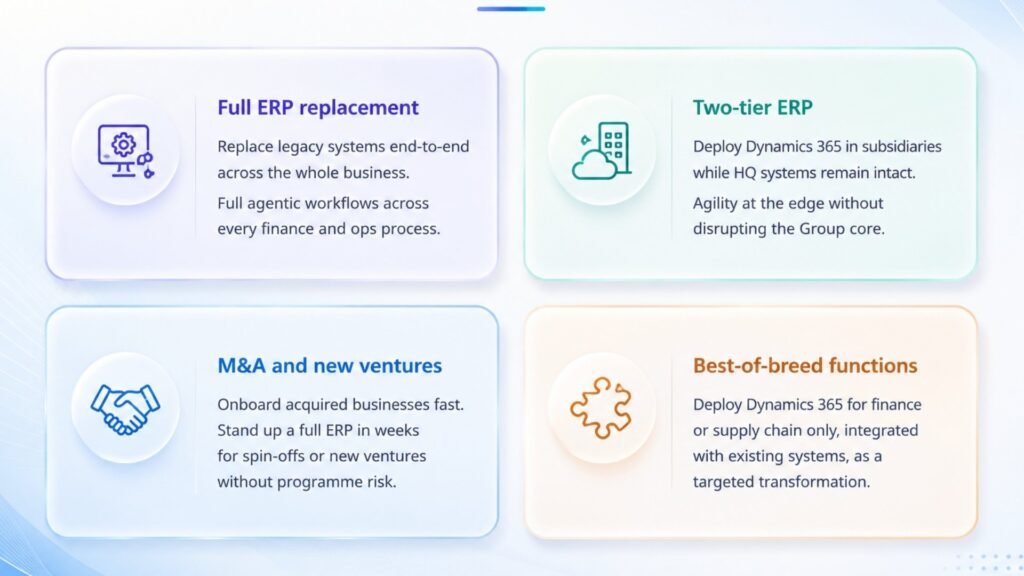
Not every organisation is ready or able to replace its entire ERP landscape in a single programme. Dynamics 365 supports both approaches. For businesses replacing a traditional system end-to-end, the migration path is well-established, with Microsoft FastTrack support and a certified partner network providing programme governance and risk management.
A global headquarters on a Tier 1 ERP and subsidiaries or newly acquired businesses that need modern, agile capabilities without waiting for a full Group-level migration. Dynamics 365 supports a two-tier deployment model. Subsidiaries operate on Dynamics 365 with full agentic capability while headquarters systems remain intact. New acquisitions can be onboarded onto Dynamics 365 in weeks rather than months.
British Chambers of Commerce published in March 2026 that more than half of UK firms are now actively using AI, up from 35% in 2025 and 25% in 2024. The 2026 benchmark report estimates that £78 billion of unrealised AI value is in the UK SME segment alone, based on scenarios in which SMEs adopt AI at rates comparable to large enterprises.
Between 2023 and 2025, large UK firms with 250 or more employees nearly doubled their AI adoption rate to 44%, while small firms with fewer than 50 employees reached just 26%. The UK’s AI uptake looks less like a rising tide and more like a two-speed race, with larger firms pulling further ahead.
The organisations that are pulling ahead are not simply buying more software. They are rethinking how their finance and operations teams work, which processes should involve human judgement, and which should be managed by agents that can work faster, more consistently, and at greater scale than human effort alone.
That is a striking set of numbers. The businesses generating those outcomes are the ones that moved from experimentation to integration. They did not run a pilot in one corner of the finance team and leave it there. They embedded AI into workflows, which changed the unit economics operation.
Agentic ERP is not a single-industry story. The specific processes it improves vary by sector. Still, the underlying pattern is consistent: agents managing volume, routine, and time-sensitive work so that people can focus on the judgement-heavy work that requires them.
Healthcare organisations in the UK, whether NHS trusts, independent providers, or private hospital groups, operate under intense financial pressure while managing clinical, regulatory, and workforce demands simultaneously. Back-office inefficiency is not a peripheral issue in this context. Time and resources diverted to manual administrative processes are time and resources not available for patient care.
The UK government’s NHS Fit for the Future Ten-Year Health Plan identifies AI as one of five strategic priorities for health transformation, alongside data, genomics, wearables, and robotics. NHS organisations will be required to reserve at least 3% of annual spend for service transformation investments, and a new procurement framework will be introduced in 2026 to 2027 to accelerate the adoption of innovative technologies, including AI.
For healthcare organisations, Dynamics 365 can centralise and automate the finance and operations processes that currently consume significant staff time. Financial reconciliation, purchase order management, workforce scheduling, and project billing for capital programmes are all areas where agents can take over routine work. The platform’s compliance capabilities are also relevant for healthcare, where audit readiness and governance over financial and operational data carry regulatory weight.
The procurement and supply chain capabilities are particularly valuable for NHS trusts and healthcare providers managing complex supplier networks for medical consumables, pharmaceuticals, and facilities services. Agents that proactively monitor supplier commitments and flag risks before they affect clinical supply chains have a direct bearing on patient care quality and operational continuity.
NHS productivity improved by 2.7% between April and July 2025 because of stronger digital foundations and wider use of modern data tools across hospitals, primary care, and integrated care systems. That improvement reflects the initial stages of embedding digital tools into healthcare operations. Agentic ERP represents the next step in that trajectory.
UK charities and non-profit organisations face a combination of pressures that make operational efficiency not just desirable but existential. Rising demand for services, reduced funding, and growing regulatory and reporting obligations all compete for the attention of teams that are typically already stretched.
According to the 2025 Charity Digital Skills Report, 76% of UK charities reported using AI tools, a significant increase from 61% in 2024. However, only 2% are using AI strategically, and 67% cite squeezed organisational finances as their biggest barrier to digital progress.
The gap between using AI tools and using them strategically is precisely the problem that an integrated agentic ERP platform addresses. A charity using a standalone AI writing assistant is doing something quite different from one that has automated its financial reconciliation, grant reporting, and procurement workflows through an integrated platform. The second organisation is getting compounding operational returns. The first is getting marginal time savings on individual tasks.
For non-profit organisations, the case for Dynamics 365 rests on a few specific areas. Grant management is one of the most time-intensive processes in the sector, involving compliance tracking, financial reporting to funders, and ongoing monitoring of spending against grant conditions. The finance and project operations modules in Dynamics 365 can automate work, reducing the cost per grant managed and freeing fundraising and programme teams from administrative overhead.
Donor and supporter management, when integrated with the finance platform, gives organisations a single view of income, programme delivery, and reporting obligations that is difficult to achieve with disconnected systems. The record-to-report process in Dynamics 365 produces accurate, timely financial statements with significantly less manual effort, which is directly relevant for charities preparing annual accounts and Charity Commission returns.
UK energy and utilities businesses face a distinctive set of operational challenges. Asset maintenance across geographically distributed infrastructure, compliance with environmental and safety regulations, workforce scheduling for field operations, and the growing complexity of managing renewable energy alongside traditional assets all create significant process overhead.
Dynamics 365 addresses operational challenges for utilities businesses. The asset maintenance capabilities in the Field Service module use sensor data and maintenance history to anticipate equipment failures before they cause unplanned downtime. Work orders are created and scheduled automatically, with technician skills, part availability, and job criticality all factored into the assignment.
For utilities businesses managing large fleets of assets, the design-to-retire process coverage in Dynamics 365 tracks assets through their full lifecycle, from acquisition and commissioning through to planned replacement. This gives finance and capital planning teams the visibility they need to make investment decisions on reliable, current data rather than estimates.
The platform’s sustainability capabilities are also particularly relevant for utilities businesses navigating Net Zero commitments and Scope 3 reporting obligations. Dynamics 365 embeds sustainability data collection into the same workflows used for procurement and operations, reducing the manual effort involved in ESG reporting without requiring a separate system.
UK retail is under pressure from multiple directions simultaneously. Online competition, rising fulfilment costs, inventory complexity across channels, and consumer expectations around delivery speed have all increased in recent years.80% of UK retailers anticipate online sales growth this year, driven by rapid AI adoption, and almost half of UK adults under 45 are already using AI for product research, price comparison, and exploring delivery options.
For UK retailers and e-commerce businesses, Dynamics 365 addresses the operational challenges that sit behind those numbers. On the fulfilment side, AI-driven demand forecasting reduces the inventory mismatches that lead to either stockouts or excess stock. The platform supports endless aisle capabilities, allowing customers to order items not currently in physical stock, with fulfilment routed intelligently across the network. Real-time inventory visibility across channels means that what customers see online reflects actual availability.
The supply chain agents in Dynamics 365 manage procurement and replenishment with a level of responsiveness that manual processes cannot match. Order-to-cash automation reduces the manual work involved in processing high volumes of orders, while financial agents manage the reconciliation work that scales with transaction volume.
The UK e-commerce sector invested an estimated £120 million in AI technologies in 2024. However, research suggests that £92 million of that spend could be at risk of underperformance if AI tools are not effectively embedded into operations. The distinction between AI tools that sit alongside operations and agents genuinely embedded in core processes is exactly where agentic ERP is effective for retail businesses.
Three things to take away from this:
Mazik Global works with businesses navigating ERP modernisation and Microsoft Dynamics 365 implementation. Whether you are replacing a traditional system, extending Dynamics 365 capability, or exploring where AI agents can have the most impact in your finance and operations teams, we can help you build a clear picture of the opportunity and the right path forward.
Every contact centre supervisor knows the feeling. A queue builds, wait times creep up, and the report that explains it…
How Do You Drive AI Adoption Across Your Organisation? Quick answer: AI adoption is the point where people use AI…

Quick answer: AI governance is the set of controls over data, access, compliance and monitoring that lets an organisation use…