Businesses have rarely faced a more demanding operating environment. Supply chain disruption, shifting trade conditions, and persistent cost pressure now arrive alongside the fastest technology shift in a generation. For finance directors and operations leaders, the question is no longer whether to modernise the ERP system. Instead, it is how quickly they can do it and what the modern version should look like.
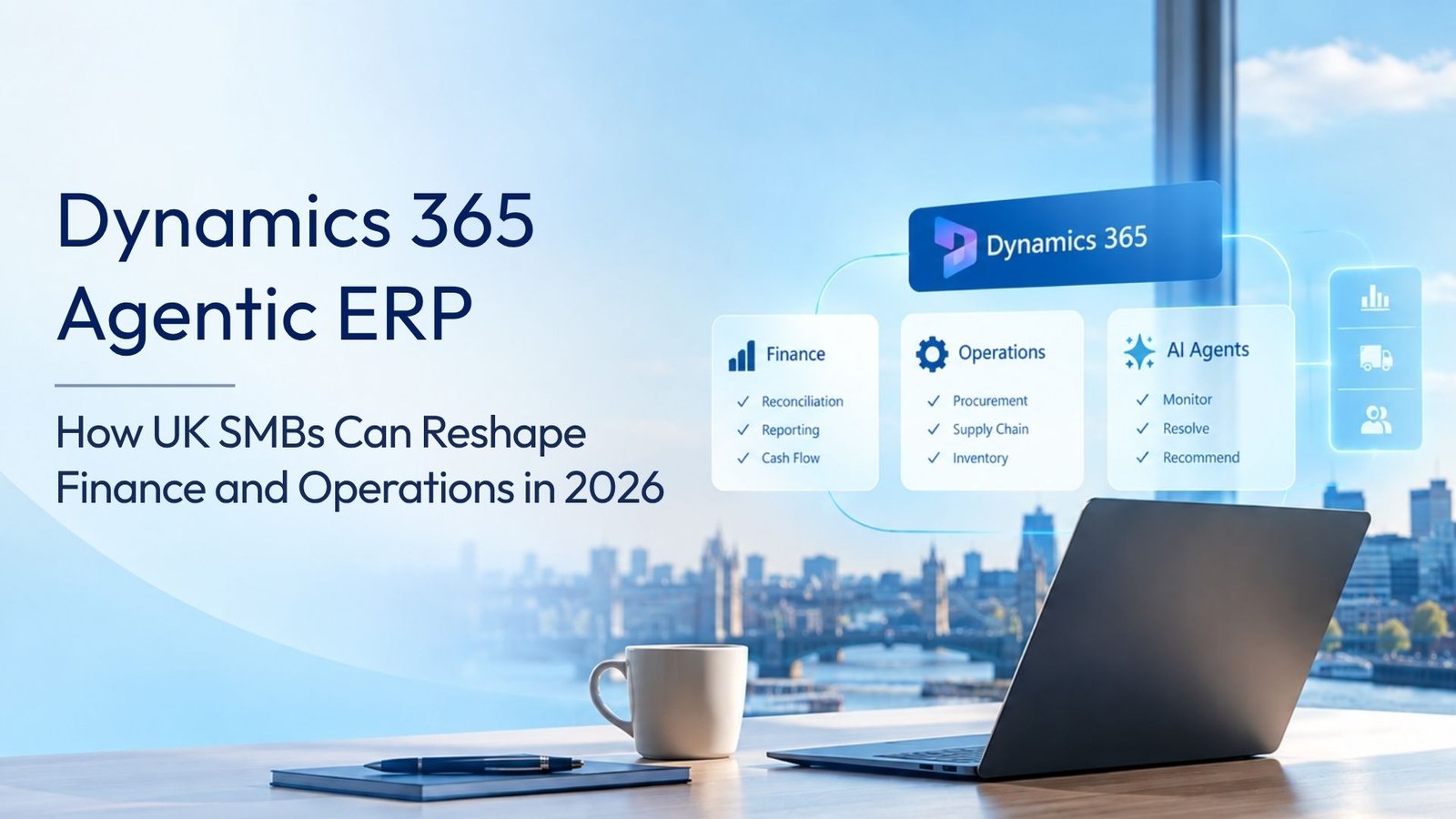
Dynamics 365 agentic ERP is the answer Microsoft and its partners are pointing towards. Rather than a standard cloud upgrade, it is a platform where AI agents work alongside finance and operations teams. These agents manage routine tasks, surface risks, and support faster decisions at a scale that manual effort alone cannot reach.
The shift is already underway across the UK. According to the British Chambers of Commerce, 54% of UK firms now actively use AI, up from 35% in 2025 and 25% in 2024. However, what separates the organisations pulling ahead is not simply that they have adopted AI. Rather, they have begun embedding it into the core processes where it genuinely changes outcomes.
Why Traditional ERP Now Holds Businesses Back
Traditional ERP systems were designed to record and report. They capture transactions, maintain ledgers, and produce outputs that people then act on. That model suited a slower world. In the current environment, however, it creates a genuine bottleneck.
Finance teams spend large portions of the week reconciling data, chasing approvals, and building reports that are already out of date on arrival. Meanwhile, operations teams manage fragmented processes and supplier communications that depend entirely on individual follow-through. The result is predictable: slow period closes, reactive decisions, and staff spending more time coordinating than doing the work that moves the business forward.
What Dynamics 365 Agentic ERP Actually Means
Agentic ERP describes an enterprise resource planning system where AI agents sit inside core processes rather than bolted on as a separate tool. These agents observe conditions, reason about what needs to happen, and then either act or recommend without waiting for a person to start the process.
In practice, this looks like a supplier communications agent that monitors open purchase orders, detects a likely delay, and contacts the supplier to resolve it. Alternatively, it looks like a reconciliation agent that works through bank matching overnight and flags only the exceptions that need human review.
The team does not disappear. Instead, human attention moves. Finance and operations professionals shift from the mechanics of a process towards reviewing, interpreting, and acting on what the agents produce. Consequently, the volume of work a team can handle without adding headcount rises substantially.
Where Dynamics 365 Delivers, Backed by 2026 Wave 1
Microsoft Dynamics 365 is the platform that makes this model real for UK businesses. Backed by Microsoft’s 2026 Release Wave 1, which runs from April to September 2026, the platform now embeds agents across finance, supply chain, projects, commerce, and HR. Three areas offer the clearest starting points for most organisations.
For procurement, agents move teams from reactive order chasing to proactive supplier management. When a purchase order needs changing, the agent handles the communication and the updates, routing only the cases that need sign-off.
For finance, the Account Reconciliation Agent in Dynamics 365 Finance matches sub-ledger balances to the general ledger and flags exceptions for review. As a result, the month-end close consumes far less senior finance time.
For project-based firms, agents automate time and expense capture and flag approval bottlenecks before they delay billing. In turn, businesses recover revenue that currently slips through late or missing entries.
Start With Pre-Built Agents, Then Extend
One early decision concerns whether to begin with the pre-built agents Microsoft provides or to build custom ones. In most cases, we recommend starting with the pre-built agents, learning what they deliver in your environment, and then extending for the processes that are genuinely unique to your business.
Microsoft has made this accessible across every level of technical skill. Copilot Studio offers a low-code environment in which business teams can configure and extend agents without deep development expertise. Starting in May 2026, Business Central also offers custom agent design via a natural-language interface. Because every agent shares the Microsoft Dataverse foundation, agents operate across CRM, ERP, and service boundaries without custom integration at each step.
Industry Applications Across the UK
Agentic ERP is not a single-sector story. The processes it improves differ by industry, yet the pattern stays consistent: agents handle volume and routine so that people can focus on judgement.
Healthcare. NHS trusts and private providers work under intense financial pressure while managing clinical and regulatory demand. The government’s Fit for the Future 10-Year Health Plan names AI as one of five transformative technologies, and it requires NHS organisations to reserve at least 3% of annual spend for service transformation. For these organisations, Dynamics 365 can automate reconciliation, purchase order management, and capital project billing, which frees staff time for patient care.
Non-profit. According to the Charity Digital Skills Report 2025, 76% of charities now use AI tools, up from 61% a year earlier, yet only 2% use it strategically. That gap is exactly what an integrated platform closes. Here, Dynamics 365 automates grant reporting, compliance tracking, and the financial statements charities prepare for Charity Commission returns, reducing the cost of every grant managed.
Public sector. Local government and central agencies face rising demand, tight budgets, and strict audit requirements. Dynamics 365 gives finance and operations teams one source of truth across procurement, case-related spend, and reporting. Furthermore, its governance and compliance controls support the transparency that public bodies must demonstrate.
Flexible Deployment for SMBs and Larger Groups
Not every organisation can replace its entire ERP landscape in one programme. Dynamics 365 supports both a full replacement and a two-tier model. Subsidiaries and newly acquired businesses can run on Dynamics 365 with full agentic capability while headquarters systems stay intact. As a result, SMBs and growing groups gain modern capability in weeks rather than waiting for a group-wide migration.
Business Outcomes
For SMBs and larger organisations alike, the gains are specific rather than vague:
- Faster period close, with reconciliation handled before staff arrive at their desks
- Reduced revenue leakage from late or missing time and expense capture
- Fewer supplier disruptions through proactive, agent-led communication
- Greater visibility from a single, connected data foundation
Ready to Explore Dynamics 365 Agentic ERP?
The move from traditional ERP to agentic ERP is not a future consideration. Organisations investing now are already separating themselves from those that wait, and the productivity gap compounds each year. That said, the sensible path starts small: prove the pre-built agents first, then extend where your business is genuinely different.
At Mazik Global UK, we help organisations unlock the full potential of Microsoft technologies with AI-driven innovation and data-led strategies. As a Microsoft Solutions Partner, we work with businesses navigating ERP modernisation and Dynamics 365 implementation, from full replacement to a two-tier roll-out across subsidiaries.
If you are ready to see what agentic ERP looks like for your organisation, our team is here to help. Book a discovery call at mazikglobal.co.uk/contact-us.