Quick answer: AI governance is the set of controls over data, access, compliance and monitoring that lets an organisation use AI safely and prove it did. Put in place early, it speeds adoption rather than slowing it, because teams know the boundaries and leaders can see what is running, on what data and to what standard.
Key takeaways
- AI governance only slows innovation when it arrives late. Agreed early, it speeds adoption up.
- Most of the foundation already exists in the Microsoft stack: Purview, Entra and Copilot’s permission model.
- Good governance controls four things: data, access, compliance and monitoring.
Ask most leaders about AI governance and you will hear a quiet worry: that control and speed pull in opposite directions. Put too many rules around AI, and innovation stalls. Add too few, and risk creeps in unnoticed.
We hear this tension in almost every boardroom conversation, and it is the wrong choice to be forced into. Strong AI governance is not the brake on adoption. Rather, it is what makes confident adoption possible in the first place.
As a Microsoft Solutions Partner, we work with organisations that have already run their first AI pilots. The pattern is familiar: the technology works and the enthusiasm is real. Then the questions arrive. Who approved this, what data did it use, and can we prove it behaved responsibly?
Without clear answers, promising pilots quietly stall. Consequently, governance becomes the difference between AI that spreads and AI that stops.
Does AI governance slow down innovation?
No. AI governance only slows innovation when it arrives too late. Usually, a team builds something useful, and only then does anyone ask about data access, compliance or risk. At that point, governance feels like a committee saying no.
In practice, agreeing the rules before you scale lets teams move faster, because they stop guessing where the boundaries sit. Meanwhile, leadership gains a clear view of what is running, on what data, and to what standard. That visibility is what turns nervous approval into genuine confidence.
Which Microsoft tools support AI governance?
Working within the Microsoft ecosystem, most of the groundwork for AI governance already exists across data, identity and the AI itself:
- Microsoft Purview classifies, labels and protects sensitive information, with data loss prevention, before AI ever touches it.
- Microsoft Entra controls which people, and which AI agents, can access which systems.
- Microsoft 365 Copilot only surfaces information a person already has permission to see.
- Power Platform managed environments and Azure AI Content Safety give technical teams guardrails for the solutions they build.
That permission model cuts both ways, however. If SharePoint sites or Teams channels are overshared today, Copilot will surface that content too. Therefore, we recommend reviewing permissions and applying Purview sensitivity labels before any wide roll-out.
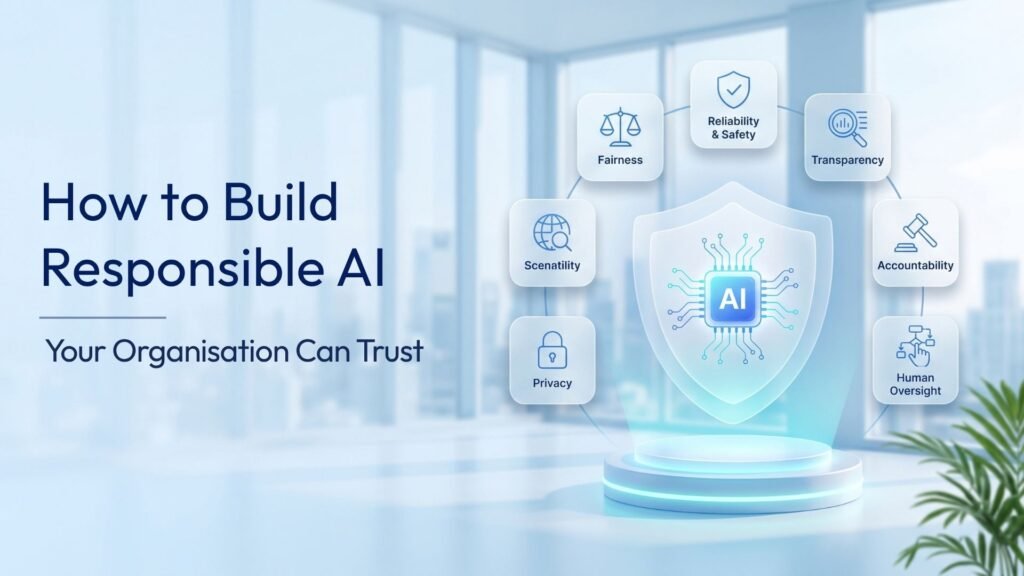
Underpinning all of this is Microsoft’s Responsible AI Standard, built around six principles: fairness, reliability and safety, privacy and security, inclusiveness, transparency and accountability. Together, they give teams a shared language for what responsible means, which is often the missing piece when different departments use the same word differently.
What should an AI governance framework control?
An effective AI governance framework is not one policy document. Instead, it is four controls working together:
- Data: AI draws only on information that is accurate, permitted and appropriate.
- Access: the right people and the right agents can act, and no one else.
- Compliance: what you do maps clearly to the standards your sector demands.
- Monitoring: you can see how AI is performing and step in when something drifts.
Get those four working, and governance stops being paperwork. In turn, it becomes the operating system that lets you say yes to more AI, not less.
How does AI governance differ across healthcare, public sector and non-profit?
The principles hold across every sector. The pressures, however, differ.
In healthcare, patient data sits at the centre of everything. NHS trusts and private providers already work to the Data Security and Protection Toolkit and clinical safety standards such as DCB0160. AI governance therefore has to fold into existing information governance rather than sit beside it. Done well, it lets clinical and operational teams use AI on administrative load without ever putting patient trust at risk.
In the public sector, transparency carries particular weight. Citizens and oversight bodies expect to understand how automated decisions are made, which is why the Algorithmic Transparency Recording Standard matters. Here, AI governance is not only about control; it is about being able to show your working.
For non-profit organisations, the challenge is usually resources. Teams are stretched, and donor and beneficiary data must be handled with care. Sensible AI governance protects that data while freeing people to spend more time on the mission and less on admin.
What are the benefits of getting AI governance right?
When governance comes first, the payoff is practical. Pilots that used to stall now progress, because the approval questions already have answers. Boards support wider roll-out, because they can see what is running and trust that it is controlled. As a result, adoption accelerates instead of stalling at proof of concept.
This is where our Crawl, Stand, Walk, Run, Win framework earns its place. Governance runs right through it, but it comes into its own at Walk, the Secure AI Adoption stage, where AI moves into everyday workflows and people build trust in the rules. Agree the foundations at Stand and apply them at Walk; the later Run and Win stages then move faster instead of stalling in firefighting.
Governance as the launchpad, not the ceiling
The organisations pulling ahead with AI are not the ones with the loosest rules. Instead, they decided early what good looks like and built the controls to match. That clarity lets them experiment boldly, because they know the guardrails will hold.
AI governance, approached this way, is not the ceiling on your ambition. It is the launchpad for it.
Frequently asked questions about AI governance
What is AI governance? AI governance is how an organisation decides what AI can do, on which data and for whom, and how it monitors and evidences responsible behaviour. It combines policy with technical controls such as data classification, access management and audit, so leaders can approve AI use with confidence.
Does Microsoft 365 Copilot respect existing permissions? Yes. Copilot only surfaces content a user can already access. As a result, any overshared SharePoint sites or Teams channels also become visible through Copilot, so we recommend reviewing permissions and applying Microsoft Purview sensitivity labels before a wide roll-out.
Which Microsoft tools help with AI governance? Microsoft Purview covers data classification, labelling and data loss prevention. Microsoft Entra manages identity and access for people and AI agents. Additionally, Power Platform managed environments and Azure AI Content Safety add guardrails for solutions your teams build themselves.
How does AI governance apply in the NHS? In the NHS, AI governance should sit inside existing information governance and clinical safety processes, including the Data Security and Protection Toolkit and DCB0160, rather than run as a separate track. Starting with low-risk administrative use cases helps build trust before AI moves closer to clinical work.
Where does governance fit in the Crawl, Stand, Walk, Run, Win framework? Organisations agree their governance foundations at Stand and apply them at Walk, the Secure AI Adoption stage, where AI moves into everyday workflows. With those foundations in place, the Run and Win stages can scale AI across the organisation without constant firefighting.
Explore AI governance at the Mazik AI Summit 2026
At Mazik Global UK, we help organisations unlock the full potential of Microsoft technologies with AI-driven innovation and data-led strategies. Speak to our team to find out how this applies to your organisation.
These are exactly the questions we will explore at the Mazik AI Summit 2026 on 4 November in London. Register your place