
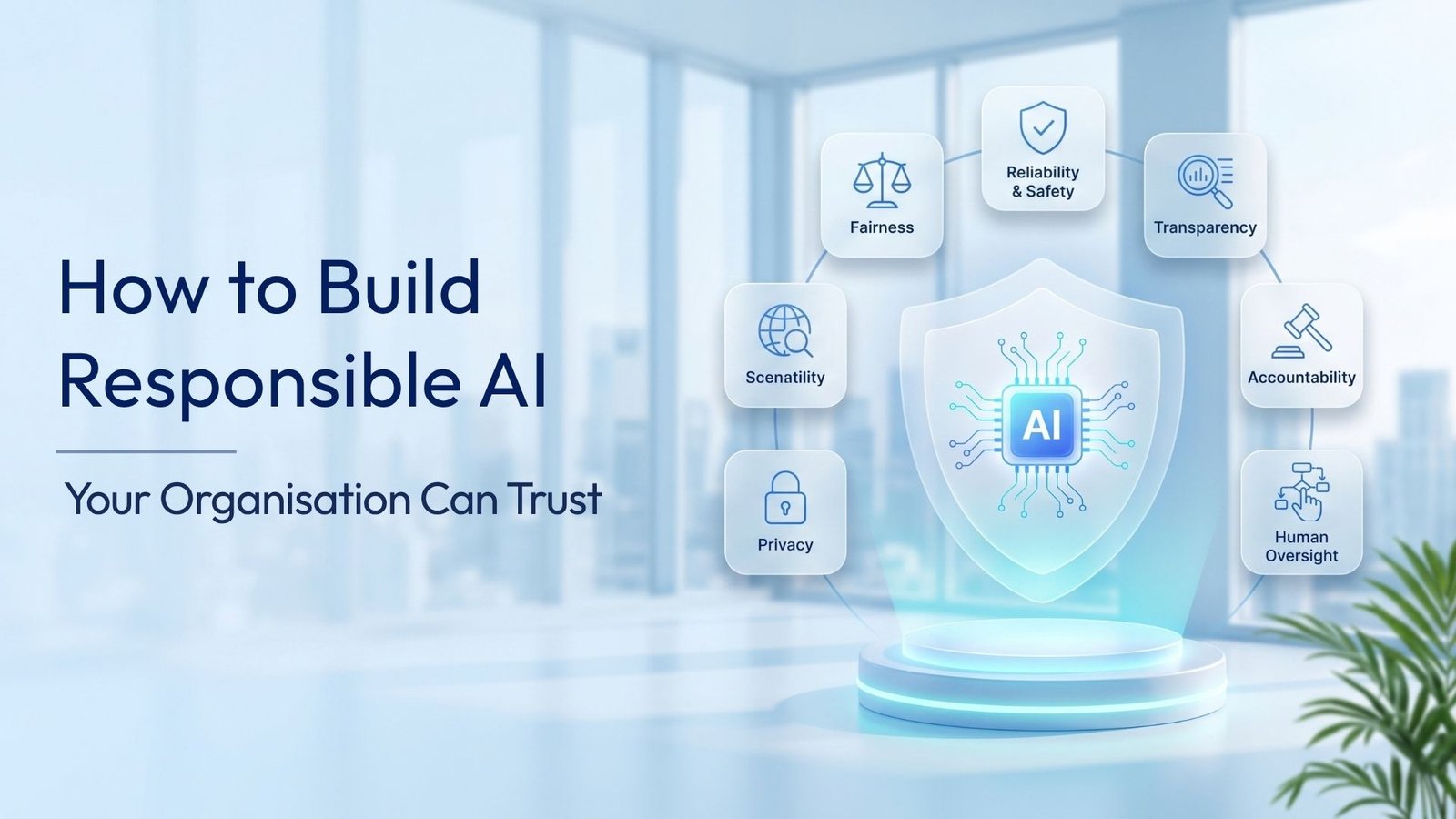
Most organisations no longer ask whether AI belongs in their business. They ask how to build responsible AI that leadership, regulators and customers can actually trust. That shift from curiosity to accountability will determine 2026. The technology is ready. The harder work is laying the right foundations.
Responsible AI is not a compliance exercise bolted on at the end. It is a set of choices made from day one: what data you use, who is accountable, how decisions are explained, and where a human stays in control. Get those choices right and adoption accelerates. Get them wrong and even a promising pilot stalls.
The pattern is familiar. A team runs a successful proof of concept, the results look strong, and then progress slows. Governance questions surface late. Data turns out to be inconsistent or poorly managed. Nobody is quite sure who owns the risk. As a result, the project never reaches the scale that would justify the investment.
This is rarely a technology failure. More often, it is a readiness failure. Organisations rush to build before they have agreed how they will govern, measure and support what they build. Responsible AI closes that gap by making trust part of the design rather than an afterthought.
As a Microsoft Solutions Partner, we build on a stack designed with responsibility in mind. Microsoft’s Responsible AI principles, covering fairness, reliability, privacy, inclusiveness, transparency and accountability, give organisations a practical starting framework rather than an abstract ideal.
Within the Microsoft ecosystem, the controls are already there to be used. Azure provides the security, identity and data governance layer. Microsoft Purview helps classify and protect sensitive information. Microsoft 365 Copilot and Copilot Studio bring AI into everyday work while respecting existing permissions and data boundaries. The task is not to invent governance from scratch. Instead, it is to apply these capabilities deliberately.
We help organisations build responsible AI through a simple progression: Crawl, Stand, Walk, Run, Win.

Crawl is about assessing and aligning. Identify the biggest sources of friction, whether fragmented data, overstretched services or manual workflows, and map your data honestly.
Stand is about strategy and use case design. Work with the people who will actually use AI to define a specific, measurable use case, with clear ownership and success criteria.
Walk is about secure adoption. Introduce AI into familiar, everyday workflows while building staff awareness, trust and a proper understanding of governance requirements.
Run is about agentic automation. Apply purpose-built AI agents to defined workflows, with the same guardrails applied throughout.
Win is about managed optimisation. Extend successful use cases across teams and departments, using the lessons from earlier deployments to keep improving data, governance and adoption.
The value of this approach is that trust grows alongside capability. Consequently, you are never scaling something you cannot govern.
In healthcare, responsible AI means reducing administrative burden and supporting clinical decisions without compromising patient safety or data protection. For NHS organisations and private providers alike, governance and explainability are not optional extras.
In the public sector, it means improving services and workforce productivity while meeting strict standards on transparency and fairness. Decision-makers must earn citizens’ trust in how they make decisions that affect them.
For non-profit organisations, it means doing more with limited resources, increasing mission impact while protecting the data of donors and the people they serve.
The technology is common across all three. However, the context, and the governance that context demands, is what changes.
When responsible AI is built in from the start, the benefits compound. Adoption is faster because people trust the tools. Risk is lower because controls are designed in rather than retrofitted. Value is easier to demonstrate because outcomes were defined before delivery began.
Just as importantly, leadership gains the confidence to scale. Instead of a scattering of isolated pilots, the organisation develops a repeatable way of turning AI investment into measurable results.
Building responsible AI is less about the size of your first project and more about the strength of your foundations. Begin with an honest assessment of your data, your governance and your goals. From there, the path from ambition to enterprise value becomes far clearer.
At Mazik Global UK, we help organisations unlock the full potential of Microsoft technologies with AI-driven innovation and data-led strategies. Speak to our team to find out how responsible AI applies to your organisation, or join us at Mazik AI Summit 2026 on 4 November in London to explore it with peers and experts.
Most organisations no longer ask whether AI belongs in their business. They ask how to build responsible AI that leadership,…
Businesses have rarely faced a more demanding operating environment. Supply chain disruption, shifting trade conditions, and persistent cost pressure now…

There is a good chance your charity is already paying for a CRM. Or, more accurately, getting one for free.…