Low-code platforms were once seen as quick fixes. Today, they are becoming central to how businesses operate. That mindset shift sets the context for the Microsoft Power Platform 2026 Release Wave 1.
Rolling out between April and September 2026, this release is less about introducing entirely new tools and more about deepening what already works, making it faster to build, smarter to automate, and more trusted to govern at enterprise scale.
The platform now spans the entire spectrum from citizen developer to professional developer to IT administrator. And with AI agents, process intelligence, and Copilot deeply embedded across every product, the gap between ‘quick solution’ and ‘enterprise-ready platform’ is closing rapidly.
As adoption grows, so do expectations. Businesses are no longer experimenting with low code. They are running critical operations on it.
That brings real pressure that the 2026 Wave 1 release addresses head-on:
Applications must scale reliably across departments and geographies
Automation needs to handle complex, real-world scenarios without breaking when systems change
Data must be available instantly, in context, and queryable in natural language
Governance must keep pace with innovation without slowing it down
AI agents must be deployable with confidence and managed with full auditability
Three themes run through the entire release: AI-driven low-code development, adaptive automation powered by agents, and governance frameworks built for scale. This is not an incremental improvement. It is the platform maturing into something enterprises can build their operations on.
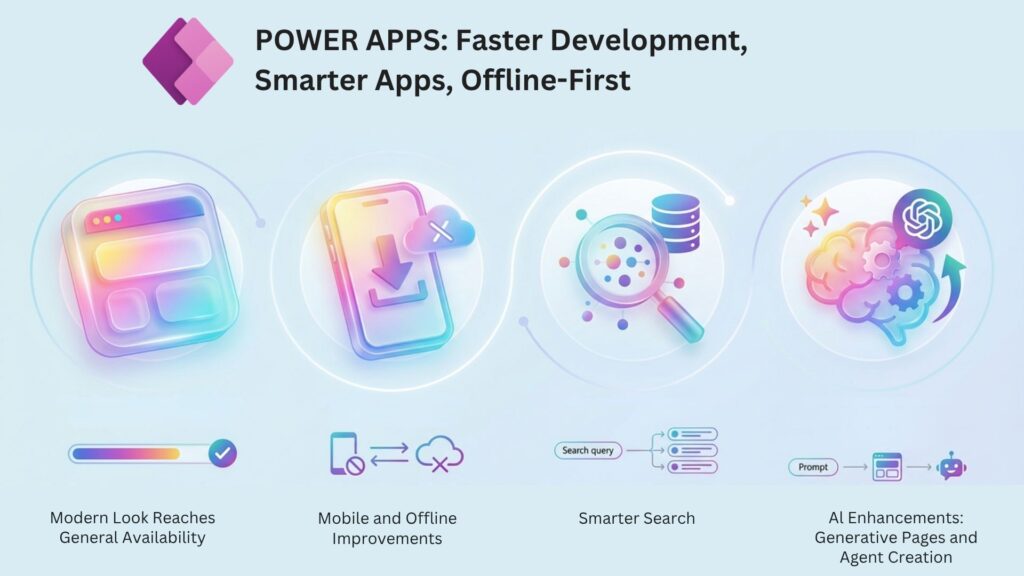
Power Apps: Faster Development, Smarter Apps, Offline-First
Power Apps continues to modernise app experiences with a refreshed model-driven UI, improved mobile and offline capabilities, faster search, and expanded AI features. This wave delivers four distinct investment areas.
1. Modern Look Reaches General Availability
The modernised interface, featuring a streamlined header and consistent navigation, is now reaching general availability and becoming the default for all model-driven apps. This is not just a cosmetic update: it brings a cleaner, more efficient experience that reduces cognitive load for everyday users and reflects a significant milestone for IT admins planning environment-wide upgrades.
2. Mobile and Offline Improvements
Canvas apps gain meaningful mobile improvements in Wave 1:
Real-time Dataverse access using online mode, giving makers a simpler path for most scenarios
Advanced offline profile configuration using FetchXML, a developer-level capability that enables precise control over what data is cached offline
Push notifications in custom-branded and white-labelled apps, enabling organisations to engage mobile users proactively
3. Smarter Search
Search in model-driven app grids and lookups now delivers faster, fuzzy results with clearer hit highlighting, so users can find the right record more quickly, even with partial or imprecise queries. For organisations with large Dataverse datasets, this is a meaningful productivity improvement for end users.
4. AI Enhancements: Generative Pages and Agent Creation
This is where Wave 1 takes Power Apps into genuinely new territory:
Generative pages, AI-generated app screens, gain broader availability and localisation, enabling faster app delivery across more markets
Row summaries in model-driven apps help teams understand and act on data faster, with expanded governance controls
Users can now create AI agents directly from existing Power Apps and deploy them to handle work autonomously, with tools to monitor agent activity and troubleshoot when agents hit roadblocks
Instead of building everything manually, users can now rely on AI-driven low-code development to generate components, surface insights, and accelerate delivery.
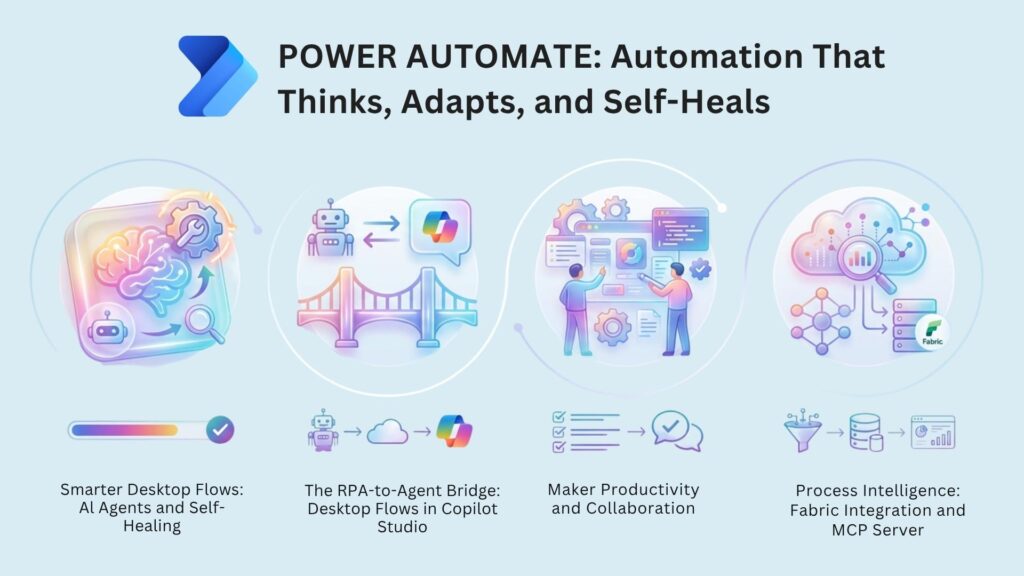
Power Automate: Automation That Thinks, Adapts, and Self-Heals
Power Automate: Automation That Thinks, Adapts, and Self-Heals
Power Automate is Microsoft’s comprehensive automation platform spanning cloud flows, desktop flows (RPA), and process mining. Wave 1 delivers substantial advances across all three, plus a new layer of process intelligence.
1. Smarter Desktop Flows: AI Agents and Self-Healing
Desktop flows Power Automate’s robotic process automation capability becomes significantly more resilient in Wave 1:
AI agent authoring enables desktop flow makers to handle complex, multi-step automation scenarios that previously required extensive manual scripting
Self-healing capabilities allow automations to automatically adapt when the underlying systems or interfaces change dramatically, reducing maintenance overhead
Flowchart views give makers a visual representation of their desktop flows, making it far easier to understand, debug, and hand off complex automations
Centralised credential management and machine templates simplify RPA deployment and governance at scale across large environments
2. The RPA-to-Agent Bridge: Desktop Flows in Copilot Studio
One of the most significant Wave 1 capabilities for automation teams: you can now call desktop flows directly from Copilot Studio for tasks that require precise, step-by-step execution. This creates a seamless bridge between AI agents and RPA. The agent handles decision-making and orchestration, and the desktop flow handles the precise system interactions. Equally, Copilot Studio-powered actions are now available in cloud flows, bringing AI capabilities into existing automation workflows.
3. Maker Productivity and Collaboration
Real-time collaboration on desktop flows, multiple makers can work on the same automation simultaneously
Enhanced version control, giving teams full history and rollback capability for their automations
Self-service restore for cloud flows makers can restore previous versions without raising an admin ticket
Flow groups enabling Process licence sharing, a new licensing mechanism that reduces cost for organisations running many flows
Capacity notifications and improved flow management for cloud flow makers
4. Process Intelligence: Fabric Integration and MCP Server
Process mining reaches general availability in object-centric mode, enabling analysis of complex, interconnected processes that span multiple objects (orders, customers, products) rather than just simple linear flows. New capabilities include:
Native Microsoft Fabric integration process intelligence data flows directly into Fabric for enterprise-wide analytics and Power BI reporting
A new Model Context Protocol (MCP) server for process mining, enabling AI-powered process insights across the Microsoft ecosystem
Custom KPIs and flexible layouts in the modern process intelligence studio workspace
Power Platform connector for process mining, enabling seamless integration with other automation and AI tools.
Instead of workflows breaking when something changes, automation becomes resilient. It adapts, learns, and improves over time. For organisations, that means less maintenance and more reliability.
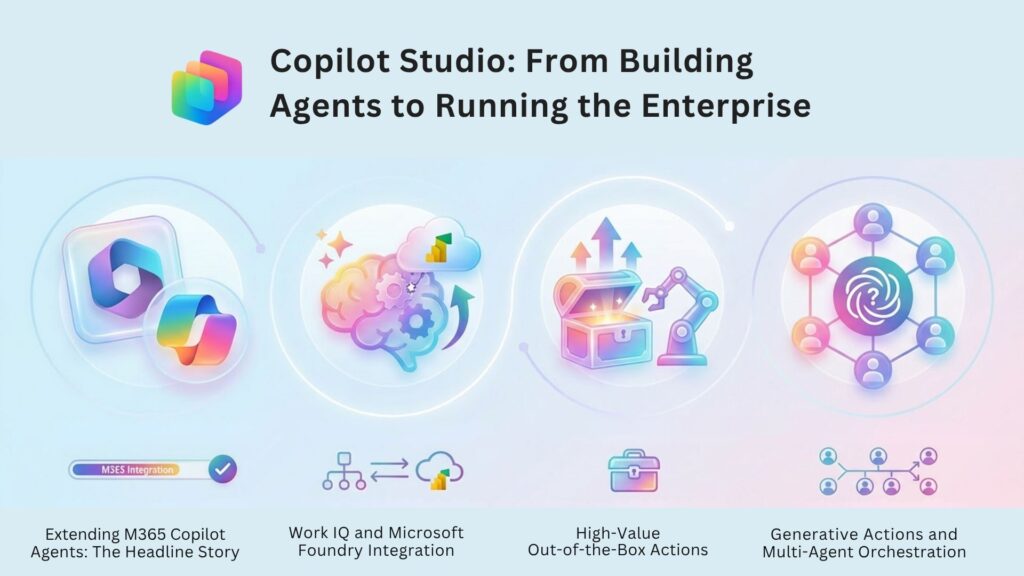
Copilot Studio: From Building Agents to Running the Enterprise
Copilot Studio: From Building Agents to Running the Enterprise
Microsoft Copilot Studio is a SaaS agent platform that helps organisations build AI agents and agentic workflows to transform business processes. Wave 1 advances it significantly beyond the basics of agent creation.
1. Extending M365 Copilot Agents: The Headline Story
The most significant new capability in Wave 1: Copilot Studio now supports extending agents built with Agent Builder in Microsoft 365 Copilot. This means organisations can take the AI agents they’ve already deployed through M365 Copilot and add:
New knowledge types, connecting agents to richer, more specific data sources
Sophisticated custom tools and skills tailored to specific business processes
Evaluation support, enabling teams to test and validate agent behaviour before deployment
This is the bridge between the M365 Copilot ecosystem that many UK organisations already use and the custom agent capabilities of Copilot Studio. For organisations that have already invested in M365 Copilot, this is a direct path to extending that investment.
2. Work IQ and Microsoft Foundry Integration
Copilot Studio agents can now leverage Work IQ – Microsoft’s organisational intelligence layer in coordination with the latest AI technology through Microsoft Foundry. This means agents are no longer limited to a single knowledge source or model. They can draw on organisational-wide data, apply the most appropriate AI model for the task, and deliver more accurate, context-aware responses.
3. High-Value Out-of-the-Box Actions
New pre-built AI actions in workflows make it significantly easier for organisations to apply AI to common automation needs without custom development. These are ready-to-use actions that connect to business processes and data sources out of the box.
4. Generative Actions and Multi-Agent Orchestration
Generative Actions: the system dynamically decides which tools (plugins) to invoke based on the user’s intent, what information to gather, and how to guide the conversation to completion. Makers set up the agent with the right plugins; AI handles the rest
Multi-agent orchestration: multiple agents can now work together across workflows, with one agent coordinating others to complete complex, multi-step processes
Deeper governance controls with managed security and IT-level visibility into agent behaviour
Across the platform, AI is no longer just assisting users. It actively participates in processes, capable of making decisions within defined boundaries.
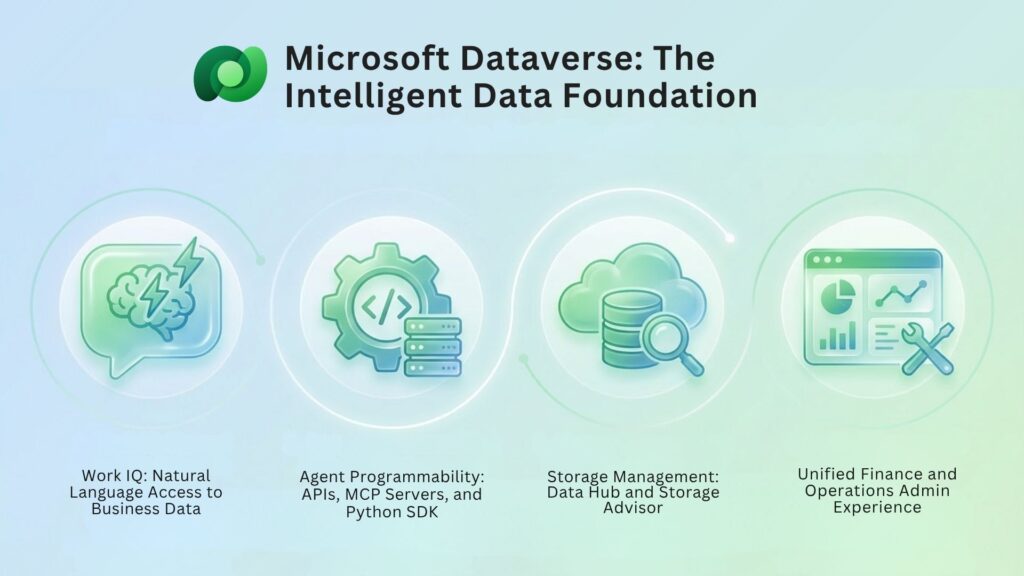
Microsoft Dataverse: The Intelligent Data Foundation
Microsoft Dataverse: The Intelligent Data Foundation
Microsoft Dataverse is the enterprise-ready data platform underpinning all of Power Platform and Dynamics 365. Wave 1 elevates Dataverse from a data store to an active, intelligent layer that agents can reason over, query in natural language, and act upon.
1. Work IQ: Natural Language Access to Business Data
The most important Dataverse update in Wave 1 is Work IQ integration. With business data natively integrated into Microsoft 365 Copilot experiences, teams can:
Access line-of-business data from Dataverse through natural conversation in M365 Copilot — no query language, no dashboards
Automate multi-step workflows through conversational prompts
Deploy autonomous agents that make smarter, organisation-specific decisions grounded in reusable skills and adaptive learning that refines over time
Maintain complete auditability through transparent agent identities in Dataverse — every agent action is traceable
For UK organisations where data is spread across Dynamics 365, SharePoint, and other Microsoft services, Work IQ provides a single intelligent layer that connects it all.
2. Agent Programmability: APIs, MCP Servers, and Python SDK
Dataverse becomes significantly more extensible for developer teams:
Dataverse Work IQ APIs and MCP servers allow developers to configure, extend, and integrate business agents into custom applications and automation workflows
The new Dataverse Python SDK provides a native development experience for rapid prototyping and scripting, particularly relevant for UK organisations with data science and ML teams who prefer Python over Power Fx or C#
Together, these tools enable teams to build tailored agent solutions that fit their organisation’s unique requirements without relying solely on low-code tools
3. Storage Management: Data Hub and Storage Advisor
New admin capabilities address a growing pain point for maturing Power Platform environments:
Data Hub provides a unified view of data consumption across the tenant
Storage Advisor delivers recommendations to manage and optimise storage usage, helping organisations avoid overage costs
Detailed finance and operations storage reporting is now available directly in the Power Platform admin centre, eliminating the need to navigate to separate F&O environments
4. Unified Finance and Operations Admin Experience
Administrators can now manage users, roles, licences, and storage for finance and operations apps environments directly within the Power Platform admin centre, without navigating to separate F&O interfaces. This is a significant quality-of-life improvement for IT teams managing both Power Platform and Dynamics 365 F&O simultaneously.
Data is no longer just stored and retrieved. It is interpreted in context, enabling more relevant insights and better outcomes.
Power Pages: Intelligent Portals with Enterprise Security
Power Pages: Intelligent Portals with Enterprise Security
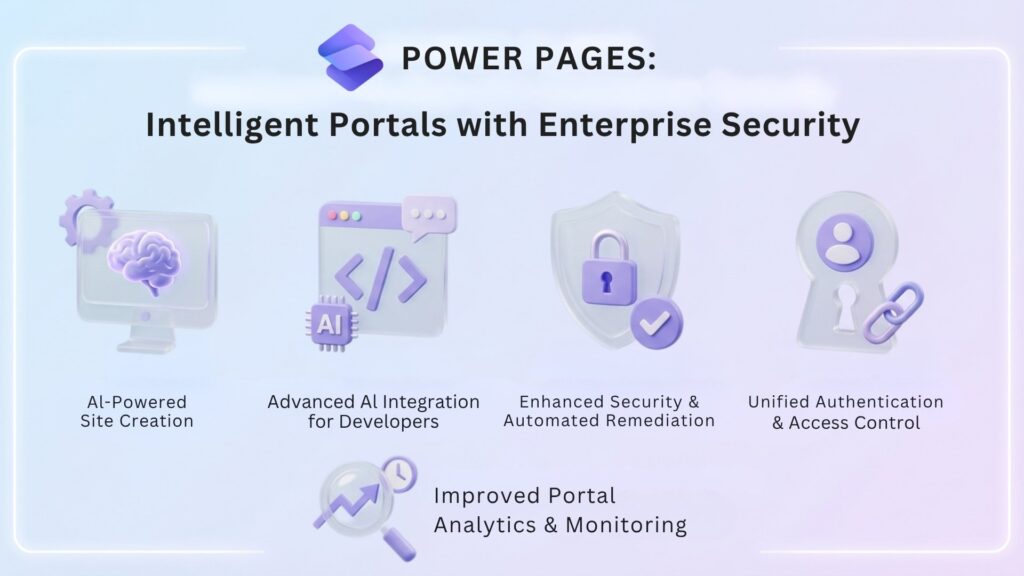
Power Pages is investing in both pro-developer capabilities and enhanced security in Wave 1 — addressing the core tension organisations face when building external-facing portals: moving fast without creating risk.
Key Enhancements
AI-assisted site creation makers and pro-developers can build portal pages faster using AI-generated layouts and content structures
Deeper integration with market-leading AI tools, pro-developers gain access to more powerful AI capabilities for building intelligent portal experiences for employees, customers, citizens, and partners
Enhanced security agent features actionable insights and automated remediation for low-code makers, pro-developers, and admins to identify and fix security issues in their portal configurations
Enhanced authentication and unified authorisation models, simplifying access management for complex multi-audience portals
Improved analytics and monitoring, giving portal owners better visibility into usage patterns and performance
These improvements make it easier to build external-facing portals that are both user-friendly and secure, without having to choose between the two.
Governance That Enables, Not Just Controls
MODULE: GOVERNANCE AND ADMINISTRATION
Governance That Enables, Not Just Controls
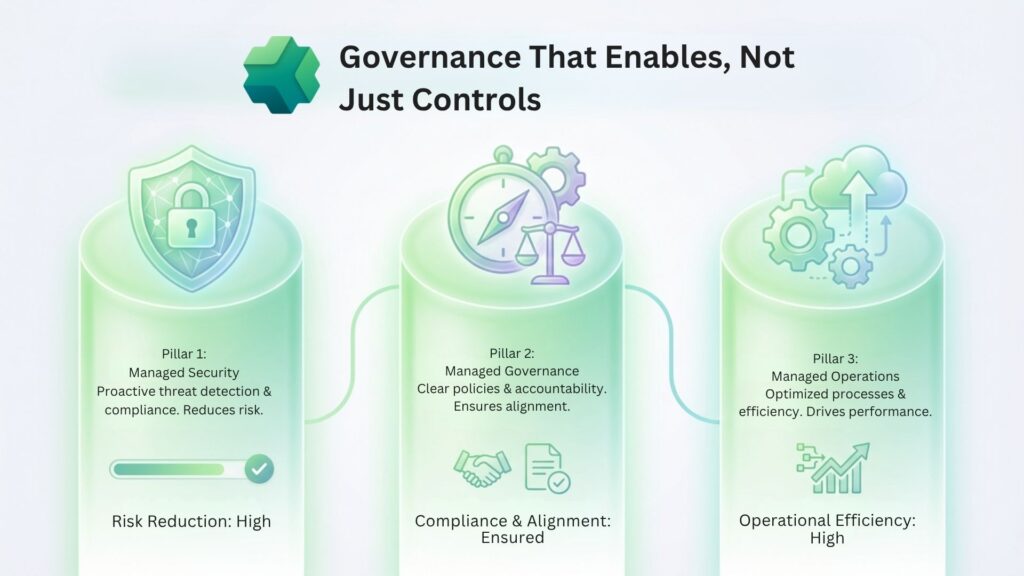
Power Platform governance and administration in Wave 1 is structured around three pillars that together form a managed platform model. As organisations scale agentic development, the admin centre evolves into a command centre for balancing enterprise control with maker innovation.
As low-code adoption grows, governance becomes critical. With increasing regulatory requirements and data protection standards, governance can no longer be reactive. It must be built into the platform from the start.
Pillar 1: Managed Security
Organisations can now configure safe innovation zones for experimentation while enforcing strict controls on production workloads. Specific capabilities include:
Sensitivity label-based data access governance controls, which data agents can access based on classification
External user permission controls define precisely what external users and agents can access
Network connectivity security for agents, ensuring agent data flows are protected end-to-end
Admin controls for agent security, enabling IT teams to govern agents across their full lifecycle
Pillar 2: Managed Governance
The shift from reactive manual reviews to proactive automated oversight:
AI-powered governance agents continuously monitor the tenant, identify risks, and provide remediations automatically
Real-time risk assessment catches security and compliance issues before deployment, not after an incident
Safe innovation zones with contextual maker guidance accelerate innovation without compromising standards
GitHub integration and deploy from Git, mature application lifecycle management with full audit trails, ensuring only reviewed, tested changes reach production
Pillar 3: Managed Operations
Proactive cost management and operational efficiency:
Granular Copilot credit tracking with configurable consumption caps, preventing budget overruns before they happen
Automated licence reclaim that returns unused licences to the pool, recovering wasted spend without manual intervention
Near-real-time health monitoring detects operational degradations within one hour, enabling faster response across Power Platform resources
Detailed usage analytics and connector dependency mapping provide the transparency needed to demonstrate ROI and quickly assess impact when connectors change
Pay-as-you-go caps for Copilot credit consumption at a granular level
What This Means Across Your Organisation
Product
Key Wave 1 Benefit
Power Apps
Extend M365 Copilot agents, Work IQ & Foundry integration, multi-agent orchestration, and generative actions
Power Automate
AI agent authoring, self-healing desktop flows, RPA-to-Copilot Studio bridge, Fabric process mining, MCP server
Copilot Studio
Extend M365 Copilot agents, Work IQ & Foundry integration, multi-agent orchestration, generative actions
Microsoft Dataverse
Work IQ natural language queries, Python SDK, Data Hub & Storage Advisor, unified F&O admin centre
Power Pages
AI-assisted site creation, enhanced security agent, pro-developer AI tool integrations
Governance & Admin
Three-pillar model (Security/Governance/Operations), Copilot credit caps, licence reclaim, GitHub/Git ALM
The Future of AI-Driven Low-Code Innovation
Microsoft is refining the platform to make it more practical, scalable, and aligned with real business needs. AI becomes embedded, not optional. Automation becomes adaptive, not static. Low-code becomes enterprise-ready, not experimental.
What Wave 1 demonstrates is that these aren’t future promises; they are happening now. Agents can be built from existing apps, extended with M365 Copilot capabilities, connected to the latest AI models through Foundry, and governed with real-time risk assessment and full audit trails. Process mining can now see complex, object-centric processes and feed insights directly into Fabric. Desktop flows self-heal. Storage advisors surface optimisation recommendations automatically.
For UK organisations, the question is no longer whether to build on Power Platform. It is how to build on it in a way that scales, stays secure, and delivers measurable return on investment.
How Mazik Global Can Help
At Mazik, we are seeing a clear shift. Organisations are no longer asking whether they should adopt Power Platform. They are asking how to scale it effectively. The challenge is not technology. It is aligning AI with real business processes, designing solutions that scale across departments, and embedding governance from day one.
Mazik Global is a UK-based Microsoft partner with deep expertise across the full Power Platform stack from citizen-developer Power Apps to enterprise-grade Copilot Studio agent deployments and Power Automate RPA programmes. We work with organisations across financial services, manufacturing, professional services, and the public sector.
What We Offer
Power Platform Implementation: End-to-end deployment of Power Apps, Power Automate, Power Pages, and Copilot Studio, configured for your business processes and governance requirements
AI Agent Design and Deployment: Building and deploying custom AI agents in Copilot Studio, including M365 Copilot agent extensions and multi-agent workflows
RPA and Automation Programmes: Desktop flow development, self-healing automation design, and the RPA-to-agent bridge using Copilot Studio
Power Platform Governance Assessment: Reviewing your current environment against the three-pillar governance model, Managed Security, Managed Governance, Managed Operations, and implementing the right controls
Dataverse and Data Architecture: Designing scalable Dataverse environments, Work IQ integration, and storage optimisation strategies
Training and Adoption: Role-based enablement for citizen developers, pro-developers, and IT admins to maximise platform value
The Microsoft Power Platform 2026 Release Wave 1 provides the foundation. The real value comes from how your organisation applies it, with the right architecture, the right governance, and the right partner.
Ready to get more from Microsoft Power Platform? Talk to the Mazik Global UK team about implementing, scaling, or governing your Power Platform environment. → Book a free consultation
Conclusion
The Microsoft Power Platform 2026 Release Wave 1 marks a clear maturation point for the platform. Power Apps can now generate agents from existing applications. Power Automate’s desktop flows self-heal and connect directly to Copilot Studio. Copilot Studio agents can extend M365 Copilot with custom knowledge and tools. Dataverse supports natural language queries through Work IQ. Governance spans security, risk assessment, and cost management in a unified three-pillar model.
For UK businesses already using Power Platform, this release unlocks significantly more value from a platform you already own. For those evaluating it, Wave 1 makes the enterprise readiness case more compelling than ever before.
The direction is set. AI is embedded, not optional. Automation is adaptive, not static. Low-code is enterprise-ready. The question now is how your organisation gets there, and how quickly.
In a world that moves faster every day, you need to be constantly evolving. Chat with a technology expert today to learn how we can help you operate efficiently, solve business challenges, and innovate effectively.
Mazik Global UK, a trusted Microsoft Solution Partner and FastTrack-recognised expert, delivers AI-powered, low-code solutions across Dynamics 365, Power Platform, and Azure, driving confident digital transformation.