
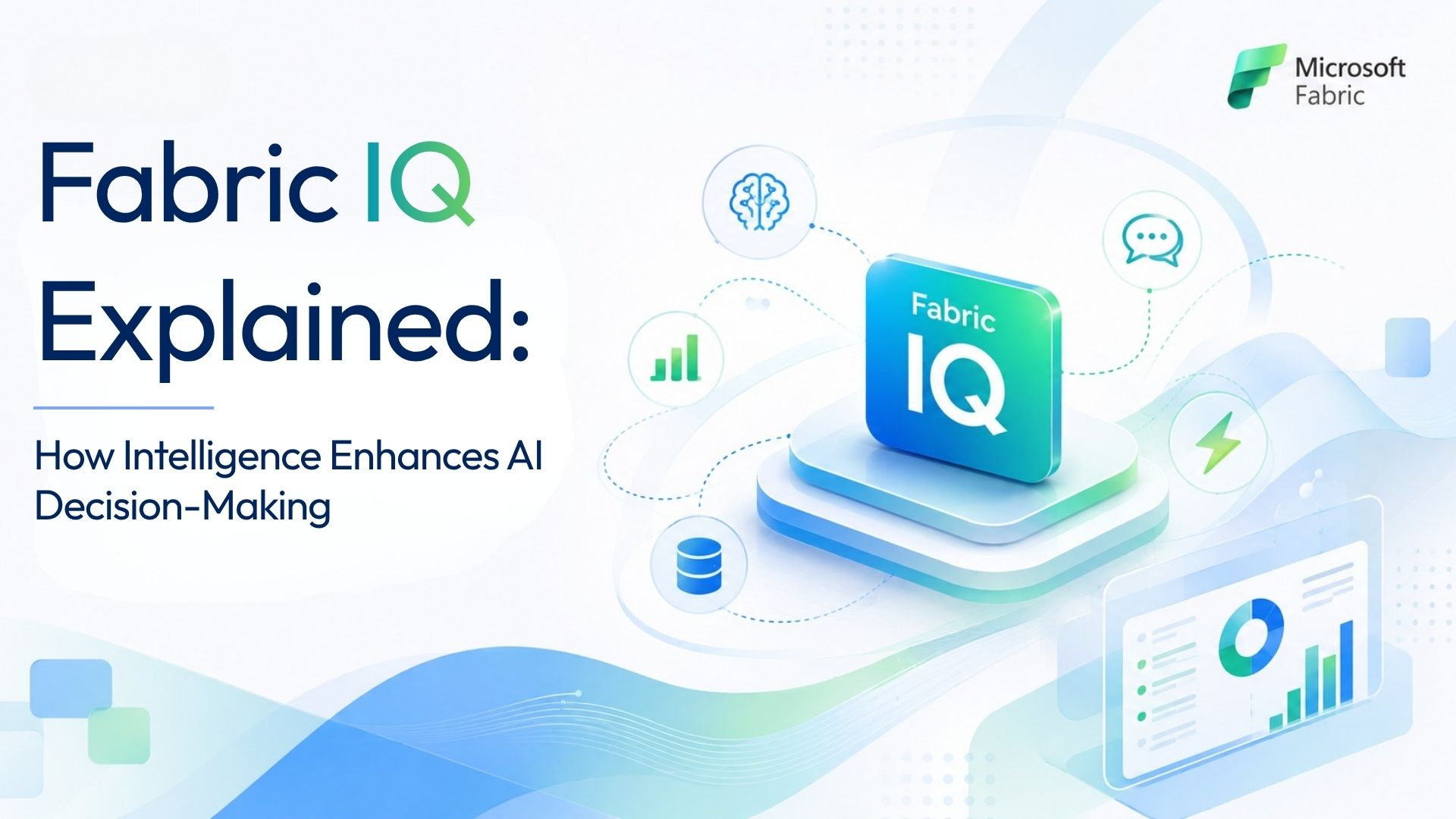
Previously, holding data was a challenge for many organisations, which has been resolved. Today, data is everywhere, systems multiply faster than teams can manage them, and the volume of information arriving at any given moment far exceeds anyone’s ability to act on it. Dashboards get built. Reports get circulated. And yet decisions still take longer than they should.
The numbers tell their own story. 64% of UK organisations now use AI in some form. Yet only 24% have reached the point where AI forms part of core business processes and decision-making.
That is where the conversation begins to shift. Having data was never the end goal. Understanding what it means in the context of business operations has always mattered. That distinction matters more than most technology teams realise, and it is exactly the problem that Microsoft Fabric IQ is designed to solve.
Microsoft Fabric is an all-encompassing, cloud-based analytics platform designed to simplify every stage of data management, from collection and storage through to in-depth analysis and visualisation.
It brings together multiple capabilities within a single unified environment built on One Lake. Fabric integrates deeply with Azure AI services. Power BI is natively embedded, so interactive dashboards and reports connect directly to the same data layer used for analytics, engineering, and AI.
Fabric IQ is an intelligence layer built into Microsoft Fabric that connects data, context, and decision-making.
It was announced at Microsoft Ignite in November 2025, and it represents a significant evolution in how organisations work with business data and AI. It is not just a dashboard but a separate system that understands & interprets the data.
Most organisations have large amounts of data stored across various systems. That data might include sales figures, financial records, operational metrics, customer interactions, and supply chain information. The problem is that this data sits in technical formats that AI systems, analysts, and even business leaders often struggle to interpret consistently.
Fabric IQ addresses this by building a shared, structured understanding of your business, its entities, relationships, rules, and metrics, and making that understanding available to both humans and AI systems. It transforms Microsoft Fabric from a unified data platform into what Microsoft describes as a unified intelligence platform.
Fabric IQ is made up of five integrated components that work together:
| Component | What it does | Why it matters |
| Ontology | Defines business entities, rules, and relationships | Gives AI a shared vocabulary for your organisation |
| Semantic Model | Extends BI definitions into operations and AI | Consistent metrics across teams and systems |
| Graph Engine | Multi-hop reasoning across connected data | Surfaces insights traditional queries cannot reach |
| Data Agent | Answers business questions using structured meaning | Natural language access to business intelligence |
| Operations Agent | Acts on real-time signals and triggers | Moves from insight to autonomous action |
These five pillars combine into something more meaningful than any individual tool. They give every team, application, and AI agent in your organisation access to the same understanding of how your business works. Instead of each system maintaining its own interpretation, everyone works from the same model.
Fabric IQ builds on One Lake to create a single, governed data foundation across the organisation. Systems such as Epic, Cerner, Dynamics 365, and third-party applications connect to a consistent data environment. This enables a unified view of data without duplication, supported by secure cross-tenant sharing and external data connectivity.
Once the semantic model is in place, users can query data in plain English without requiring technical skills or knowledge of data structures. For example:
These queries are grounded in organisational definitions, allowing business users to access trusted insights directly.
Direct Lake enables Power BI to query large datasets directly from One Lake without scheduled refresh cycles. This removes delays between data updates and reporting, improving responsiveness for operational decision-making.
Built-in AI and machine learning capabilities support summarisation, classification, and content generation directly on One Lake data. Fabric IQ ensures these outputs are grounded in the business context rather than generic data interpretations.
Copilot within Fabric enables users to explore data and generate insights using natural language. With Fabric IQ providing semantic grounding, responses are aligned to organisational definitions and metrics.
Fabric provides enterprise-grade governance through lineage tracking, workspace controls, and integration with Microsoft Purview. Fabric IQ enhances this by adding semantic meaning without duplicating data, ensuring governance remains consistent and efficient.
The challenge with using AI for business decisions is not that AI lacks capability. The challenge is that AI lacks business awareness. A foundation model can answer general questions very well. It struggles when you ask it to reason about your specific pipeline stages, your approval workflows, or the way your organisation categorises customer risk.
Without a shared semantic layer, AI systems default to guesswork. They interpret data based on generic patterns rather than the specific logic your organisation uses. The outputs look plausible but do not align with business operations. Fabric IQ changes this dynamic.
It moves from:
Around 64% of organisations in the UK use AI, yet only 24% have embedded it into core decision-making processes. That gap between usage and real impact is exactly what Fabric IQ is designed to close.
Understanding the mechanics of Fabric IQ helps clarify why it produces better AI outcomes than traditional approaches.
Everything starts with data, but not just static datasets. Fabric IQ works with live signals coming from across your environment:
Built within Microsoft Fabric, it has visibility across the data estate rather than isolated sources. The key difference is that it treats data as something active, not something stored.
Fabric IQ does not look at data points in isolation. It connects them.
For example:
It starts to understand relationships between events, not just the events themselves. This is what turns information into context.
Once context is established, Fabric IQ can move a step further.
It begins to interpret what matters. Instead of presenting ten different insights, it highlights the one that needs attention now. Instead of leaving teams to figure out next steps, it can suggest actions based on patterns and priorities.
This is where intelligence enhances AI decision-making, not by replacing human judgment, but by narrowing the gap between data and decision.
Here’s a cleaner, more structured version in professional UK English with the comparison presented as a table:
The impact of Fabric IQ gains clarity when viewed through an example.
Consider an example in which a finance director asks Copilot, “How are we tracking against our Q2 targets across our three primary product lines?”
| Aspect | Without Fabric IQ | With Fabric IQ |
| Data Interpretation | Copilot searches across documents and emails to assemble a generalised response. | Copilot uses a structured ontology aligned to your organisation’s data definitions. |
| Accuracy of Metrics | Outputs may not reflect the finance team’s agreed definitions or calculation methods. | Metrics are based on predefined business rules, ensuring consistency and accuracy. |
| Context Awareness | Limited understanding of business-specific terms such as “Q2” or performance thresholds. | Fully aligned with organisational context, including fiscal periods, KPIs, and thresholds. |
| Reliability for Decision-Making | Requires manual validation and interpretation before use in decision-making. | Provides decision-ready insights without additional verification. |
| Outcome | Technically correct in isolation but lacks business relevance. | Context-rich, precise, and directly aligned with how the business operates. |
The underlying data remains unchanged. What Fabric IQ introduces is a layer of understanding, enabling AI to interpret not just the data itself, but its meaning within the context of your organisation.
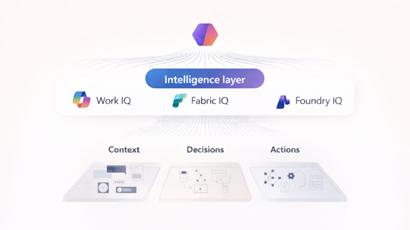
Fabric IQ does not operate in isolation. It integrates with Work IQ, which understands how people collaborate and work, and Foundry IQ, which handles the retrieval of unstructured organisational knowledge. When a Copilot query is made, all three layers contribute to grounding the response, combining workflow context, business data meaning, and enterprise knowledge into a single, coherent answer.
| Feature | Traditional BI | Basic Copilot | Fabric IQ |
| Understands business terms | Partial | No | Yes |
| Cross-system data reasoning | No | No | Yes |
| Natural language queries | No | Basic | Advanced |
| Real-time business context | No | No | Yes |
| Governance built in | Manual | Limited | Full (Microsoft Purview) |
| Works with AI agents | No | Partial | Yes |
UK organisations are at an important moment in their AI journeys. According to the Department for Science, Innovation and Technology (DSIT), 85% of businesses that invest in AI have increased their spending over the last five years, with 73% reporting an increase of more than 20%. Yet despite this investment, adoption of AI for business processes remains limited.
The UK government’s AI Opportunities Action Plan emphasised the importance of embedding AI across the economy to support productivity and competitiveness. Fabric IQ represents a practical route for organisations to do exactly that, particularly in sectors where data governance and accuracy are non-negotiable requirements.
For regulated industries such as healthcare and financial services, the governance architecture is as important as the analytical capability. Fabric IQ supports compliance with standards, including GDPR and sector-specific requirements, and its integration with Microsoft Purview means data security policies are applied consistently across the platform.
For UK organisations operating under GDPR, sector-specific data regulations, or both, the governance architecture behind Fabric IQ is as important as its capabilities. Fabric IQ is built within Microsoft Fabric’s existing governance framework, meaning:
Integration with Microsoft Purview means that sensitivity labels and data loss prevention policies apply consistently across Fabric IQ. Audit trails are maintained for agent actions, which is particularly relevant for regulated industries where data accountability is a requirement rather than a preference.
Fabric IQ does not duplicate the data. It builds semantic meaning on top of data that remains in One Lake, so there is no additional data movement or replication involved. This keeps your governance model clean and reduces the risk of data going places it should not.
At Mazik Global, we focus on making AI practical, structured, and aligned with real business needs. As a certified Microsoft Solutions Partner, our approach to Fabric IQ implementation is designed to support the full lifecycle, from initial assessment through to long-term optimisation.
We define a tailored roadmap based on your organisation’s needs, focusing on key business entities, metrics, and high-impact AI decision use cases.
We integrate Microsoft Fabric and Fabric IQ into your existing environment with minimal disruption, connecting systems such as Dynamics 365, Epic, Cerner, and third-party platforms into One Lake with built-in governance.
We manage end-to-end data migration into Fabric with a strong focus on security, compliance, and data integrity throughout the transition.
We extend Fabric with Azure analytics and AI services to create a scalable, intelligent data ecosystem that supports advanced analytics and decision-making.
We deliver role-based training for business users and technical teams. We support ongoing assistance to ensure sustained adoption and value realisation.
We bring deep expertise across Microsoft Fabric, Power BI, Azure AI, and enterprise data architecture, ensuring your semantic layer accurately reflects your business and evolves with it.
Working with Mazik Global provides organisations with direct access to the Microsoft product roadmap as a Solutions Partner. This enables clients to benefit from visibility capabilities and strategic guidance that reflects the future direction of the platform, not just its current state.
We bring extensive experience across healthcare, financial services, and the public sector. These environments demand rigorous compliance and strong data governance. Our implementations are designed with these requirements embedded from the outset, ensuring alignment with regulatory and operational standards.
Every solution is designed around the organisation’s objectives rather than delivered as a standard template. We focus on understanding business priorities and tailoring implementations to deliver measurable and relevant outcomes.
We take an innovation-led approach, leveraging the latest capabilities within Microsoft Fabric and Fabric IQ. This ensures our clients are not only optimised for current requirements but are also positioned to take advantage of future developments in the platform.
The organisations gaining the most from AI are not always those with the largest datasets or the most advanced models. They are the organisations that have given AI a genuine understanding of how their business works.
Fabric IQ represents a concrete, practical way to achieve that. It transformed Microsoft Fabric from a capable data platform into an intelligence platform, one where AI systems reason about your business using your definitions, your logic, and your priorities. Combined with the broader capabilities of Microsoft Fabric, including unified data integration, Direct Lake mode, Copilot-powered analytics, and enterprise governance, it creates an AI-ready data foundation that most organisations have been trying to build for years.
For organisations that have already invested in AI but are not seeing the expected depth of value, the challenge is rarely model capability. It is context. Fabric IQ addresses this by grounding intelligence in meaningful business understanding.
Business data intelligence is set to become a standard component of enterprise AI architecture. The real decision is timing: whether to build this foundation now and gain a competitive advantage, or later when it becomes a baseline expectation.
Contact Mazik Global to schedule a Fabric IQ readiness assessment and discover how context-aware business data intelligence can transform your organisation together.
Every contact centre supervisor knows the feeling. A queue builds, wait times creep up, and the report that explains it…
How Do You Drive AI Adoption Across Your Organisation? Quick answer: AI adoption is the point where people use AI…

Quick answer: AI governance is the set of controls over data, access, compliance and monitoring that lets an organisation use…