
Healthcare is finally moving into the stage of actual transformation. The global market for data interoperability in healthcare is projected to exceed £135 million in 2025 and rise to over £355 million by 2030, growing at a CAGR of over 14.7%.
These numbers tell a simple story: healthcare organisations worldwide are fed up with disconnected systems. They need a better way forward, and Microsoft Fabric healthcare interoperability offers exactly that.
Microsoft Fabric allows healthcare organisations to unify information within a single cloud environment. It’s a genuine step forward for providers building a cloud-first healthcare data strategy. The platform delivers reliable healthcare data integration with Microsoft Fabric and real-time healthcare data analytics that reach clinicians and analysts simultaneously.
Built on Microsoft Cloud for Healthcare, the solution integrates seamlessly with existing clinical systems whilst providing the foundation for advanced analytics and AI capabilities.
In this blog, we’ll explore how Microsoft Fabric healthcare interoperability is shaping the future of connected healthcare across NHS Trusts and private hospitals alike.
Inside most hospitals, every department speaks a different digital language. This disconnect costs time, money, and sometimes outcomes. However, the real impact is more concrete than many realise.
NHS Trusts waste an average of 15 to 20% of analyst time on manual data reconciliation. Private hospitals see 10 to 15% revenue leakage from incomplete billing data. Clinical teams lose 2 to 3 hours daily searching across disconnected systems. Meanwhile, delayed diagnostics extend average length of stay by 0.8 days per patient.
Across both NHS Trusts and private providers, common issues include:
Microsoft Fabric healthcare interoperability addresses these problems directly. Built as a Microsoft Fabric unified data platform, it connects Epic, Cerner, Meditech, PAS, and local systems into one governed space within OneLake.
Consequently, data interoperability in healthcare becomes more than a buzzword. With a cloud-first healthcare data strategy, it’s finally achievable.
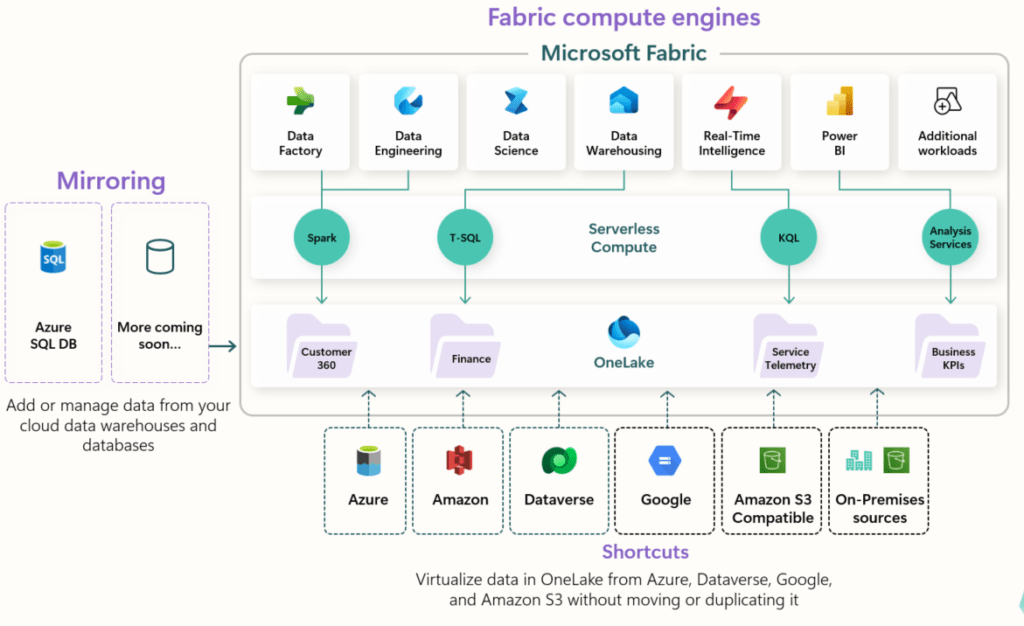
The problem isn’t the lack of data. Rather, it’s the lack of connection between systems. Microsoft Fabric healthcare interoperability provides that missing link.
Here’s how it works in practice:
Fabric’s OneLake acts as a single data lake that connects EPRs, imaging, IoT, and financial systems without duplication or manual exports. Everything lives in one place, accessible to authorised users across the organisation.
The platform supports FHIR (Fast Healthcare Interoperability Resources), OMOP (Observational Medical Outcomes Partnership), and DICOM so that clinical, operational, and diagnostic data align under consistent models. This matters particularly for NHS Trusts working towards Federated Data Platform compliance and private hospitals pursuing quality accreditation.
Through its bronze-silver-gold structure, Fabric keeps data clean, traceable, and compliant. Raw data comes in at bronze level, gets standardised at silver, and becomes analytics-ready at gold. Meanwhile, governance sits at every layer, ensuring NHS Data Security and Protection Toolkit (DSPT) compliance and GDPR Article 9 special category data handling.
With the Fabric AI Agent and Copilot, clinicians and analysts can query live data in plain language and receive instant, visualised insights. There’s no need for SQL knowledge or ticket requests to IT.
Built-in encryption, role-based access, and NHS-aligned governance enable secure healthcare data exchange without compromising compliance. Data never leaves the Microsoft Azure environment, and audit trails track every access point.
Because Fabric is cloud-native, hospitals can add new systems and data sources easily. Therefore, as organisations grow or merge, the platform grows with them.
Beyond connecting systems, Microsoft Fabric enables live operational insights that traditional data warehouses simply cannot match.
Capture real-time feeds from IoT devices, admission systems, and theatre management platforms. This means bed sensors, vital signs monitors, and scheduling systems all feed into one unified stream.
Query millions of clinical events in milliseconds for instant operational visibility. Ward managers can check current capacity across all wards in seconds, not minutes.
Set automated triggers. For instance, when theatre utilisation drops below 70%, alerts go to scheduling teams. When A&E wait times exceed four hours, escalation protocols activate automatically.
Sync operational databases without ETL overhead, ensuring EPR data is always current. This is particularly valuable for private hospitals tracking revenue per consultant or NHS Trusts monitoring A&E performance against national targets.
For organisations requiring decisions backed by live data rather than yesterday’s reports, these capabilities change everything.
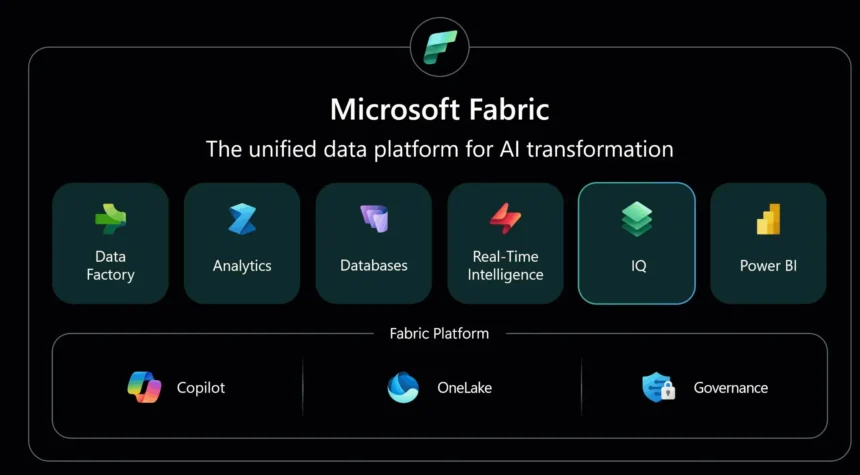
Beyond connecting systems and delivering real-time data, healthcare organisations need AI that understands the language of medicine. Microsoft Fabric IQ provides exactly that, a semantic intelligence layer that transforms raw healthcare data into a structured model of how your organisation operates.
Introduced in November 2025, Fabric IQ represents a fundamental shift from data platforms to intelligence platforms. For healthcare, this means AI agents and analytics tools can finally reason about patients, care pathways, and clinical processes the way your experienced clinicians do.
Traditional analytics tools understand columns and values. Fabric IQ understands that “Patient A had readmission within 30 days post-discharge due to medication non-compliance” rather than just seeing disconnected data points across separate tables.
At the core of Fabric IQ sits the Ontology, a visual, no-code model of your healthcare operations. Instead of complex data engineering, clinical and operational experts can define entities (Patient, Admission, Procedure, Medication, Consultant, Ward), relationships (Patient → Admission → Procedure → Outcome), rules (Sepsis pathway protocols, discharge criteria), and actions (Trigger alerts, update care plans, notify teams).
| Use Case | What It Does | Business Impact |
| Clinical Pathway Optimisation | Defines pathways like “Elective Hip Replacement” as connected entities from referral through surgery to discharge. Tracks every patient and identifies bottlenecks. | Reduced delays, standardised care, improved outcomes |
| Readmission Risk Prediction | Models relationships between patient characteristics, procedures, discharge medications, and historical readmissions. Identifies high-risk patients before discharge. | 15% reduction in 30-day readmissions, targeted interventions |
| Resource Allocation Intelligence | Connects bed occupancy, theatre schedules, staff rosters, and patient acuity. Operations Agents automatically adjust staffing and predict capacity constraints. | 20% improvement in resource utilisation, proactive capacity management |
| Medication Safety | Defines relationships between medications, allergies, concurrent prescriptions, and adverse events. Flags contraindications in full clinical context. | Reduced medication errors, improved patient safety, compliance with NICE guidelines |
For NHS Trusts working with FHIR or OMOP standards, Fabric IQ provides the missing link. FHIR defines how to structure clinical data. OMOP defines a common research model. Fabric IQ defines how your organisation actually uses that data, your specific pathways, your local protocols, your trust-specific definitions. Consequently, you can maintain FHIR compliance for interoperability whilst having an ontology layer that reflects your unique operational reality.
Whilst Fabric Copilot assists with specific tasks, Data Agents represent a step change in healthcare analytics. These are AI-powered virtual experts that understand your data, speak your clinical language, and provide instant answers to complex questions.
Data Agents are conversational AI systems built on your healthcare data and powered by your Fabric IQ ontology. Unlike general AI chatbots, these agents are trained specifically on your organisation’s data model, clinical terminology, and operational context. Think of them as having a senior clinical analyst available 24/7 to every clinician, manager, and executive, one who knows your EPR data, understands your pathways, and can answer questions in seconds rather than days.
Data Agents connect directly to your unified data in OneLake. They understand your Epic extracts, Cerner tables, PAS data, PACS metadata, and finance systems because they’re built on the same Fabric IQ ontology that defines these relationships. Users ask questions in plain English via Teams, web interface, or mobile app. The agent understands context, follows up with clarifying questions if needed, and provides visualised answers with source attribution.
| Role | Example Questions | What They Get |
| Ward Managers | “Which patients on my ward are medically fit for discharge but waiting for social care packages?”<br>”Show me trends in falls incidents over the last 6 months by time of day and staffing levels” | Instant lists with patient details, visualised trends with drill-down capability |
| Clinical Leads | “Which consultants have readmission rates above trust average for laparoscopic cholecystectomy?”<br>”Compare our surgical site infection rates for hip replacements against national benchmarks” | Consultant-level performance data, benchmarking charts with peer comparisons |
| Finance Directors | “What’s our revenue per theatre hour by specialty compared to budget?”<br>”Which high-cost drugs have the biggest variance against forecast this quarter?” | Financial dashboards with variance analysis, cost driver identification |
| Executive Teams | “Summarise our performance against the NHS Oversight Framework metrics”<br>”What’s driving the increase in length of stay for emergency admissions this month?” | Executive summaries with key metrics, root cause analysis with recommendations |
Healthcare can’t afford black-box AI. Data Agents provide full transparency. Every answer shows source data with lineage. Users can click through to underlying Power BI reports. Audit trails track all queries and responses. Furthermore, because agents are built on your Fabric IQ ontology, the business rules and constraints are visible and governed by your organisation, not hidden inside a model.
Most organisations start with 2-3 focused agents: Clinical Performance Agent (A&E, RTT, theatre utilisation, bed occupancy), Quality and Safety Agent (incidents, complaints, readmissions, mortality), and Finance and Activity Agent (revenue, activity, productivity, variance analysis). These agents are built during your 12-week Fabric implementation and trained on your first months of live data.
After connecting the systems, the next step is making the data work. Microsoft Fabric healthcare interoperability does this through a straightforward process that turns raw information into real-time insight.
Data from Epic, Cerner, PAS, imaging systems, and IoT devices flows into OneLake through secure, pre-configured pipelines. In the NHS, this approach aligns with the Federated Data Platform (FDP) framework for compliance and consistency.
For private hospitals, the same pipelines handle billing systems, insurance claim tracking, and consultant scheduling platforms. Everything connects without custom coding or manual file transfers.
Once inside OneLake, Fabric’s bronze-silver-gold layers clean and map data into FHIR and OMOP models. This offers seamless healthcare data integration with Microsoft Fabric across EPRs, imaging, and operational systems.
The transformation happens automatically. Raw HL7 messages become FHIR resources. Local coding systems map to SNOMED CT. Lab results align with LOINC standards. Consequently, analysts work with consistent, interoperable data regardless of which system it originated from.
On top of these datasets, Power BI and the Fabric AI Agent deliver instant, natural-language insights. It’s real-time healthcare data analytics built for everyday decision-making.
A ward manager can ask, “Which wards have discharge delays over six hours today?” and get an answer in seconds. A finance director can ask, “What is the revenue per consultant by specialty and location?” without waiting for month-end reports.
A typical NHS Trust using Microsoft Fabric healthcare interoperability might follow this pathway:
| Phase | Actions | Outcomes |
| Step 1: Connect Core Systems | Connect EPR, PAS, pathology, imaging, bed management, pharmacy, A&E triage systems into OneLake | Single source of truth for all clinical and operational data |
| Step 2: Transform to Standards | Transform data into FHIR-compliant format mapped to OMOP Common Data Model | Compatibility with NHS programmes and research initiatives |
| Step 3: Build Real-Time Dashboards | Create Power BI dashboards tracking A&E wait times, bed occupancy (15-min updates), elective surgery backlog, SHMI trends, theatre utilisation, diagnostic imaging turnaround | Live operational visibility with automated alerts |
| Step 4: Enable Natural Language Queries | Deploy Fabric AI Agent and Data Agents trained on trust data and terminology | Ward managers, clinical leads, executives ask questions in plain English, get instant visualised answers |
Result: Clinical and operational teams access insights in seconds, not days. Furthermore, the trust can demonstrate compliance with NHS England data standards and contribute to national benchmarking programmes without additional manual effort.
Private hospitals face different pressures. Whilst clinical quality remains paramount, financial performance and consultant satisfaction drive sustainability.
Microsoft Fabric healthcare interoperability supports private providers with:
| Capability | What You Get | Typical Results |
| Revenue Cycle Optimisation | Real-time billing completeness monitoring, insurance claim tracking, revenue per consultant by specialty, price point analysis and margin visibility | 15% reduction in revenue leakage, faster claim processing, improved cash flow |
| Consultant Performance Insights | Individual dashboards showing case mix, outcomes, theatre utilisation, readmission rates, patient satisfaction scores, peer benchmarking (anonymised) | Increased consultant satisfaction, quality improvement, transparent performance conversations |
| Patient Pathway Analytics | End-to-end patient journey mapping from initial enquiry through treatment to follow-up, bottleneck identification in digital front door | 25% reduction in time to treatment, 40% improvement in patient satisfaction scores |
| High-Value Patient Identification | Predictive analytics to identify patients for targeted care pathways or premium service offerings | Better patient outcomes, optimised service mix, increased revenue per patient |
| Group-Wide Performance Management | Consolidated reporting across multiple sites with site-level detail, benchmarking between hospitals, centralised clinical governance | Data-driven C-suite decisions, operational excellence across the group |
A 200-bed private hospital using Microsoft Fabric might achieve:
These improvements translate directly to the bottom line whilst simultaneously improving clinical outcomes and patient satisfaction.
As a long-standing Microsoft Solutions Partner, Mazik Global helps healthcare organisations move from fragmented systems to connected operations with Microsoft Fabric healthcare interoperability.
Here’s how we do it:
As Microsoft’s Healthcare and Life Sciences Partner of the Year (2021 to 2023), we’re not generalists adapting to healthcare. Instead, we’re specialists who understand NHS workflows, private hospital billing cycles, and clinical terminology.
Our team includes former NHS IT directors, clinical informaticists, and data architects with decades of combined healthcare experience. Consequently, we speak your language and understand your constraints.
Mazik’s Microsoft Fabric for Healthcare offering focuses on connecting fragmented systems through a single, secure environment. We bring EPR, imaging, IoT, and financial data together in OneLake and give healthcare providers a live view of operations and patient outcomes.
Speed matters in transformation projects. Our 12-week programme delivers quick, tangible outcomes.
| Phase | Timeline | Key Deliverables |
| Discovery and Foundation | Weeks 1-4 | Current state assessment, data governance framework, OneLake architecture blueprint, security mapping, priority use cases defined |
| Build and Transform | Weeks 5-8 | Data ingestion pipelines configured, FHIR/OMOP transformation implemented, initial Power BI dashboards, user acceptance testing, data quality validation |
| Deploy and Enable | Weeks 9-12 | Fabric AI Agent and Data Agents deployed, user training sessions, go-live support, documentation, handover to managed services |
The approach combines Microsoft Fabric unified data platform capabilities with Azure OpenAI tools. It transforms raw EPR and non-EPR data into FHIR-compliant formats and connects them to AI-driven insights with Microsoft Fabric.
As a result, you get a working data ecosystem ready for analytics, reporting, and predictive modelling in weeks, not years.
We build compliance into the foundation, not as an afterthought. Our implementations include:
Every data flow, storage location, and access control aligns with DSPT requirements. We help trusts maintain and evidence their compliance through built-in audit trails.
Role-based access controls, data minimisation principles, and privacy by design are embedded in the architecture. Our implementations follow ICO guidance on health data.
For NHS Trusts working towards FDP compliance, our Fabric implementations align with national standards for data architecture, governance, and interoperability.
Health data requires special protections. Our implementations include appropriate safeguards, consent management where required, and clear legal bases for processing.
Compliance isn’t static. Therefore, we provide continuous monitoring, regular compliance reviews, and updates as NHS standards evolve.
Adopting new technology is only half the story. Keeping it optimised is where long-term success happens.
Mazik’s managed IT services help healthcare organisations sustain a cloud-first healthcare data strategy without disruption. Our services include:
Proactive monitoring of data pipelines, system performance, and user access patterns. Issues get identified and resolved before they impact operations.
Regular reviews of query performance, storage costs, and user adoption. We identify opportunities for improvement and implement optimisations.
As NHS standards, FHIR specifications, and GDPR guidance evolve, we update your platform to maintain compliance.
As new data sources emerge or user numbers grow, we scale the platform seamlessly. Whether you’re adding a new hospital site or integrating a new EPR system, we handle the expansion.
Ongoing training, user documentation updates, and support for new use cases ensure your team gets maximum value from the platform.
As demands evolve, we help scale the platform from single-site deployments to national data programmes.
Healthcare organisations adopting Microsoft Fabric healthcare interoperability report measurable improvements across the board.
| Category | Metrics |
| Efficiency Gains | 70-80% reduction in manual reporting effort<br>50% faster access to clinical decision support<br>30% improvement in operational efficiency metrics |
| Financial Impact | £2M average annual savings (500-bed NHS Trust)<br>15% reduction in revenue leakage (private hospitals)<br>40% reduction in data-related IT support costs |
| Clinical Outcomes | 25% reduction in diagnostic delays<br>20% improvement in bed utilisation through better discharge planning<br>15% reduction in 30-day readmissions through predictive analytics |
| Compliance and Governance | Real-time compliance visibility across all data assets<br>90% reduction in time to generate regulatory reports<br>Complete audit trails for all data access and transformations |
For NHS Trusts facing mounting backlogs and private hospitals competing on outcomes, this isn’t optional. It’s essential.
The traditional approach of custom integrations, manual reporting, and siloed systems simply cannot keep pace with modern healthcare demands. Furthermore, as AI and machine learning become central to clinical decision support, the need for unified, high-quality data becomes even more critical.
Microsoft Fabric healthcare interoperability provides the foundation for this future. It brings together:
If you’re ready to modernise your data estate and build a cloud-first healthcare data strategy, the pathway is clearer than you might think.
Most healthcare organisations we work with start in one of three places:
Begin with one high-value use case such as A&E performance monitoring, theatre utilisation optimisation, or revenue cycle analytics. Prove the value quickly, then expand to additional use cases.
Launch a comprehensive data modernisation programme that addresses multiple use cases simultaneously. This approach works well for organisations with executive sponsorship and dedicated transformation funding.
Use regulatory requirements such as FDP alignment or DSPT compliance as the catalyst for modernisation. Build a compliant platform that also delivers operational value.
Regardless of where you start, the 12-week delivery model provides a structured pathway to success.
Mazik Global has delivered Microsoft Fabric healthcare interoperability for healthcare providers. Our experience spans NHS Trusts, private hospital groups, and specialist providers.
We understand the challenges you face because we’ve helped organisations just like yours overcome them. Whether you’re struggling with fragmented systems, manual reporting, compliance pressures, or simply want to harness your data for better outcomes, we can help.
Healthcare’s future depends on how well data connects. Microsoft Fabric healthcare interoperability makes that connection possible. It turns complexity into clarity through a unified, secure, and intelligent cloud platform.
If you’re ready to move from fragmented systems to unified, AI-powered insights, contact Mazik Global today. Let’s build your pathway to modern healthcare data architecture together.
Mazik Global is a Microsoft Solutions Partner specialising in healthcare data transformation. As Microsoft’s Healthcare and Life Sciences Partner of the Year (2021-2023), we help NHS Trusts and private healthcare providers modernise their data estates with Microsoft Fabric, Power BI, and Azure AI.
Learn more at www.mazikglobal.co.uk or email info@mazikglobal.co.uk
Every contact centre supervisor knows the feeling. A queue builds, wait times creep up, and the report that explains it…
How Do You Drive AI Adoption Across Your Organisation? Quick answer: AI adoption is the point where people use AI…

Quick answer: AI governance is the set of controls over data, access, compliance and monitoring that lets an organisation use…