

Finance teams in the UK carry a weight that rarely appears on an organisation chart. They close the books, run variance analysis, manage collections, support every business unit’s planning cycle, and field ad hoc requests from leadership, all while staying compliant with ever-changing regulatory requirements. They do this with fewer people than the scale of those responsibilities would suggest.
The pressure is measurable. UK professional services firms were losing over 50 hours per week to manual finance processes alone, from investigating year-end discrepancies to correcting and updating project financial records. 70% of UK finance professionals believe outdated processes could actively limit their company’s ability to scale. These are not edge cases. They describe how most finance functions run today.
The expectation placed on finance teams is clear:
What makes this difficult is that financial data sits across ERP systems, spreadsheets, email threads, and shared drives. Getting to a coherent picture means pulling everything together manually, every single time. Finance Agent in Microsoft 365 Copilot is built to address this problem.
Microsoft 365 Copilot is Microsoft’s AI layer built into the productivity applications most organisations already use daily, including Outlook, Excel, Teams, and Word. Rather than adding a separate tool to an already crowded technology stack, Copilot brings AI aid directly into the surfaces where finance work already happens.
It draws on data from across your Microsoft 365 environment, connected business systems, and your organisation’s own content to generate contextual, role-relevant responses. For finance professionals, which means an assistant that understands the work you are doing, not just the prompt you have typed.
Finance Agent in Microsoft 365 Copilot is purpose-built for the structure and rigour of modern financial operations. It is designed around core finance workflows and grounded in ERP data, so organisations can move from insight to action faster without compromising financial controls, governance, or auditability.
The Finance Agent delivers a set of purpose-built AI capabilities designed for finance teams. It accelerates financial operations by delivering correct, analysis-ready data and insights and by automating key steps in core financial processes. It surfaces capabilities in familiar interfaces for finance professionals: Excel, Outlook, and Microsoft 365 Copilot.
The rebranded Microsoft Copilot for Finance will reflect a broader shift in the positioning of the product. It is no longer described as a writing assistant for finance. It is an active participant in financial workflows.
Finance Agent runs within the Microsoft 365 Copilot framework and connects to your organisation’s existing ERP environment. The table below outlines the key components.
| Part | What It Does |
| ERP Connection | Links to Dynamics 365 Finance, SAP, and other supported ERP systems through guided setup in Microsoft AppSource |
| Microsoft 365 Integration | Works natively within Excel, Outlook, and Teams without added configuration |
| Role-Based Access | Surfaces insights relevant to each user’s role and permissions, so a CFO sees different data from a business unit manager |
| Microsoft Copilot Studio | Underpins the agent framework, enabling extensibility and future configuration |
| Security and Governance | Runs within your existing Microsoft 365 tenant with no new infrastructure to provision or a separate AI environment to secure |
| Home Workspace | A centralised dashboard that proactively surfaces key metrics, risks, and areas requiring attention |
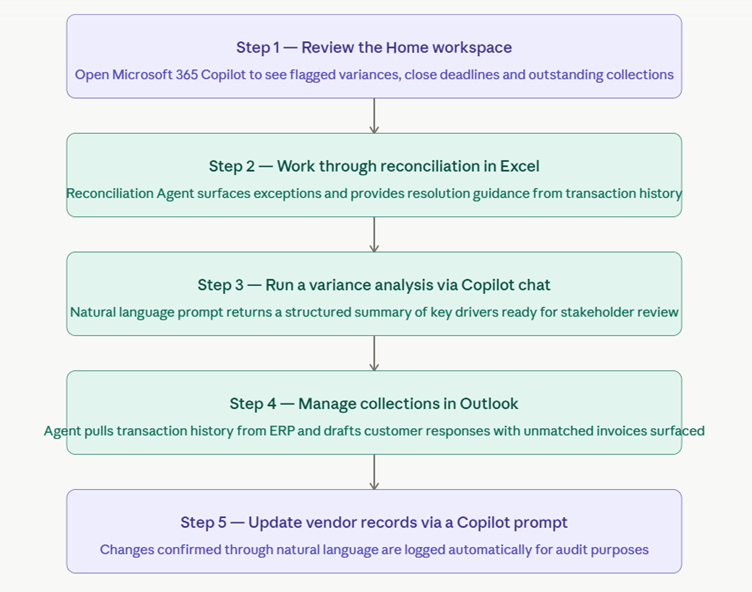
Financial reconciliation streamlines one of the most time-intensive aspects of the close cycle. By finding unmatched transactions, surfacing exceptions, and guiding resolution, Finance Agent reduces manual effort while supporting financial control and auditability.
The Financial Reconciliation Agent can compare intercompany invoices between lending and borrowing legal entities, reconcile accounts receivable and accounts payable statements shared by customers and vendors, and compare tax transactions in ERP to the statements reported to tax authorities.
Variance analysis accelerates the path from actuals to explanation. When performance deviates from expectations, the Finance Agent finds key drivers and produces structured summaries that support faster decision-making and stakeholder alignment.
Rather than spending hours building pivot tables and writing narrative commentary, finance professionals can focus on interpreting and communicating results to the business.
Financial data preparation accelerates the path from raw data to reliable insight. When financial data is inconsistent or incomplete, Finance Agent automatically cleanses, standardises, and enriches datasets, ensuring they are ready for reconciliation and analysis while reducing manual effort and improving confidence in outcomes.
In Outlook, Finance Agent supports the collections process. Users can connect to their ERP from Outlook and access valuable insights from customer data in the ERP system. It helps in writing email responses and saving communication summaries and action items for scaled impact.
The Home workspace is a financial command centre, proactively surfacing key metrics, emerging risks, and areas requiring attention. A finance leader can quickly find variances affecting forecast accuracy, while a business unit leader can check performance against targets without needing to request or reconcile multiple reports.
The Chat experience lets users interact with financial data and processes using natural language, so asking a question about an unpaid invoice or a budget variance does not require navigating across multiple modules.
Finance teams have spent years being asked to do more with the same headcount. The traditional response has been more spreadsheets, longer hours, and workarounds that create their own complexity. What the agent changes is not the volume of work, but where that work happens and how much of it requires direct human involvement.
| Activity | Without Finance Agent | With Finance Agent |
| Period-end reconciliation | Manual export, spreadsheet matching, manual investigation | Agent finds exceptions and surfaces resolution guidance |
| Variance analysis | Hours building pivot tables and writing commentary | Natural language prompt returns structured analysis with key drivers |
| Collections process | Manual email drafting with ERP lookup | ERP-connected drafts generated in Outlook with transaction history |
| Financial data preparation | Manual cleansing and standardisation | Agent automatically cleanses, standardises, and enriches datasets |
| Leadership reporting | Manual assembly from multiple sources | Centralised Home workspace with role-aware financial summaries |
| Audit trail | Dependent on manual documentation | Actions logged automatically within the Microsoft 365 governance framework |
Here is how Finance Agent supports a finance professional through a standard working day:
The UK has one of the largest finance workforces in Europe, with approximately 1.4 million people employed across finance and insurance as of 2024. But scale does not resolve complexity, and teams are still running with processes that have not kept pace with the demands placed on them.
A 2025 survey of 500 UK finance professionals found that the majority were already using AI regularly for financial analysis, forecasting, generating reports and insights, and fraud detection. According to a 2026 Moneypenny study, finance showed an 83% AI adoption rate among UK businesses, placing it among the highest across all sectors alongside HR and legal. What has often been missing is a solution that fits natively within the tools finance teams already rely on, without requiring separate environments, new vendor relationships, or significant IT overhead.
6% of UK companies have fully automated their accounts payable operations, while 47% still rely on mostly or entirely manual workflows. Finance Agent does not need a wholesale overhaul of existing processes. Because it runs within Microsoft 365 and connects to your existing ERP, it meets finance teams where they are.
Healthcare and the NHS: Finance functions in healthcare run under significant resource pressure. Tools that reduce manual workload, reconciliation, reporting, and collections free up finance professionals to focus on the analytical work that genuinely supports service delivery decisions.
Non-Profits: Organisations with limited resources but significant compliance and reporting obligations benefit from the efficiency gains Finance Agent delivers across reconciliation, data preparation, and stakeholder-facing reporting.
Financial Services: Banks, insurers, and asset managers deal with high volumes of reconciliation activity across regulated environments. Finance Agent’s auditability and ERP-connected reconciliation capabilities are particularly relevant here, where accuracy and traceability are non-negotiable.
Professional Services: Consulting, legal, and accountancy firms often carry complex multi-entity structures and project-based financials. Finance Agent’s variance analysis and financial data preparation capabilities help these organisations close faster and report more clearly without expanding headcount.
Retail and Manufacturing: Month-end close is often delayed by intercompany reconciliation and inventory-linked financial data. Finance Agent addresses both by automating the identification and resolution of discrepancies across entities and data sources.
For UK organisations working under GDPR, FCA requirements, HMRC Making Tax Digital obligations, or NHS information governance standards, any AI tool embedded in financial workflows must meet a high bar on data handling and auditability.
Finance Agent runs within Microsoft 365 Copilot and deploys to your existing Microsoft 365 tenant configuration. There is no new infrastructure to provision and no separate AI environment to secure. Administrators manage permissions, configure data connections, and check adoption through familiar Microsoft 365 admin centres.
All actions taken by the agent are logged within the Microsoft 365 governance framework, creating a traceable audit trail without requiring manual documentation. Role-based access ensures that financial data is only surfaced to users with permissions within the ERP system, supporting the integrity of financial controls throughout.
Microsoft continues to invest in Finance Agent as a central part of its broader vision for agentic ERP. Enterprise systems move from recording transactions to actively reasoning with data and supporting decisions. The Microsoft 2026 release wave one focuses on making Finance Agent the daily command centre for finance insights by strengthening conversational access to trusted financial data, expanding in-context experiences, and enabling deeper configuration, governance, and extensibility. Planned and in-progress developments include:
Mazik Global is a Microsoft Solutions Partner with deep experience delivering Dynamics 365, Microsoft 365 Copilot, and AI solutions across UK organisations in healthcare, professional services, non-profit, and the public sector.
Getting value from the Finance Agent requires more than switching it on. It requires connecting it correctly to your ERP environment, aligning permissions and governance to your existing controls, and helping your finance team understand how to incorporate it into the way they work. Our approach is structured around practical outcomes in four phases:
Phase 1: Readiness Assessment. We review your current ERP environment, Microsoft 365 licensing, and finance workflows to confirm what Finance Agent can connect to and where the highest-value use cases are for your organisation.
Phase 2: Deployment and Configuration. We manage the connection between the Finance Agent and your ERP system through Microsoft AppSource and configure role-based access and governance settings. We set up the home workspace for your finance team and key stakeholders.
Phase 3: Adoption and Enablement. We work with your finance team to build Finance Agent into day-to-day workflows, covering reconciliation, variance analysis, data preparation, and collections. The focus is on practical use rather than theoretical capability.
Phase 4: Ongoing Support and Optimisation. As Microsoft releases new capabilities across each wave, we help you stay current, evaluate what is relevant to your organisation, and expand usage as confidence and value grow.
If you are running Dynamics 365 Finance, Business Central, or SAP, Finance Agent is ready to connect to your existing environment. No separate AI infrastructure. No new vendor relationship to manage.
Finance teams are not short on data. They are short on time and capacity to turn that data into the clear, prompt insight the business needs from them. Finance Agent in Microsoft 365 Copilot addresses that gap by managing the assembly and pattern-matching work that currently consumes so much of a finance professional’s day.
For UK organisations already invested in Microsoft 365 and Dynamics 365, the path to adoption is shorter than that of most comparable tools. Finance Agent runs within your existing environment, connects to your existing ERP, and delivers inside the applications your team uses every day.
Businesses have rarely faced a more demanding operating environment. Supply chain disruption, shifting trade conditions, and persistent cost pressure now…

There is a good chance your charity is already paying for a CRM. Or, more accurately, getting one for free.…

Summary: Assisted living providers are facing rising operational complexity, from workforce pressures and compliance demands to fragmented systems and limited…