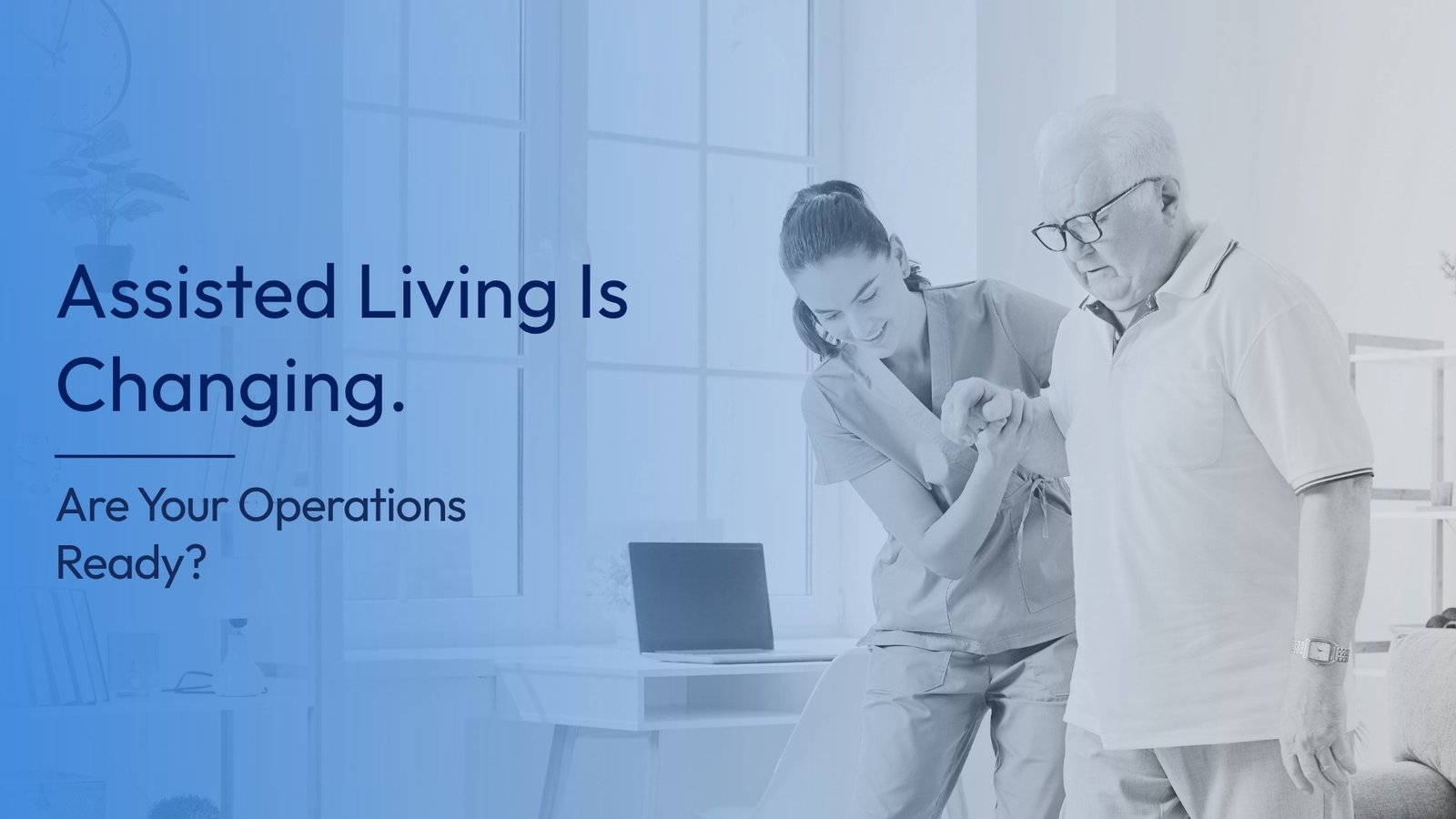
Summary: Assisted living providers are facing rising operational complexity, from workforce pressures and compliance demands to fragmented systems and limited visibility. This article explores why connected operations are becoming essential, how Microsoft Dynamics 365 creates a stronger operational foundation, and how Microsoft Fabric, Copilot and Power Platform can help care organisations move from disconnected reporting to intelligent decision-making.
For years, the conversation around assisted living has focused on one question: How do we deliver better care?
It is the right question, but it is no longer the only one that matters.
Today’s assisted living providers are expected to deliver exceptional resident experiences while managing increasing regulatory requirements, workforce shortages, financial pressures and growing expectations from residents’ families. Many organisations are also expanding into multiple locations, introducing another layer of operational complexity.
These pressures are not unique to a single provider or region. They reflect a broader shift taking place across the care sector. According to Skills for Care’s latest workforce report, the adult social care sector needs roughly 410,000 additional posts by 2040 simply to keep pace with an ageing population — even as vacancy rates ease. Demand is not slowing down. It is changing shape.
The organisations responding most successfully are not simply investing in new technology. They are rethinking how their entire organisation operates.
Because while compassionate care happens between people, consistent care depends on connected operations.
That distinction is becoming increasingly important.
In this article
- Why assisted living operations are becoming more complex
- Why visibility, not technology, is the real transformation challenge
- How connected Microsoft platforms support finance, HR, resident engagement and operations
- How Microsoft Fabric, Copilot and Power Platform extend the value of Dynamics 365
- Why transformation depends on people, adoption and continuous improvement
Care Is Becoming More Complex. Operations Need to Keep Up.
Every assisted living organisation understands the importance of investing in people: recruiting experienced carers, supporting clinical teams, improving resident wellbeing and creating environments where people feel safe, respected and valued.
Yet operational systems often receive far less attention, despite influencing almost every interaction across the organisation.
A resident enquiry may begin in one application, while contracts live somewhere else, HR teams work in another system, finance relies on spreadsheets, and managers create reports manually.
Individually, these processes seem manageable. Collectively, they create friction. As organisations grow, that friction compounds: a new care home does not simply add more residents; it introduces more employees, suppliers, contracts, compliance requirements and information to manage.
Growth itself rarely creates operational complexity.
It exposes it.
The Real Challenge Is Not Technology
When organisations begin planning digital transformation programmes, discussions often revolve around replacing legacy software.
While legacy systems can certainly limit performance, they are rarely the underlying issue.
The bigger challenge is that information remains disconnected.
- Finance operates independently from HR.
- Resident services operate independently from finance.
- Operational teams maintain their own reporting.
Senior leadership receives information days or even weeks after important decisions should have been made.
This creates what many healthcare organisations experience today:
A visibility gap.
Most assisted living providers do not have a technology problem. They have a visibility problem.
Without trusted, real-time information, even experienced leadership teams struggle to answer fundamental operational questions.
- Which homes are operating most efficiently?
- Where are staffing pressures increasing?
- Which services generate the greatest operational cost?
- How quickly are resident enquiries progressing?
- Where are administrative bottlenecks emerging?
The information often exists. It is not connected.
Assisted Living Has Become a Data Business
This may sound surprising. After all, assisted living is fundamentally about people, and always will be.
But every decision made inside a modern care organisation depends on information.
- Occupancy planning
- Workforce scheduling
- Financial forecasting
- Resident engagement
- Supplier management
- Compliance reporting
- Clinical administration
- Executive decision-making
Each relies on accurate, accessible and timely data.
Yet many providers continue to manage these critical activities through disconnected applications introduced over many years to address individual departmental needs.
The result is an organisation that works harder than necessary simply to stay coordinated. This is why operational modernisation is increasingly becoming a business conversation rather than an IT conversation.
Leadership teams are no longer asking, “Which software should we buy?”
They are asking something much more strategic: “How do we create an organisation where every department works from the same version of the truth?”
That shift changes everything.
Microsoft’s Perspective: Connected Organisations Make Better Decisions
One of Microsoft’s biggest strengths has never been individual applications.
It has been creating an ecosystem where applications share information instead of competing for it. Rather than treating finance, HR, customer engagement and operational management as separate disciplines, Microsoft has spent years building business applications around a single principle:
Connected organisations make better decisions.
That philosophy is reflected throughout the Microsoft Cloud. Microsoft Dynamics 365, Microsoft 365, Azure, Power Platform and Microsoft Fabric are not isolated products.
Together, they create an intelligent business platform where information moves naturally across departments.
This is particularly valuable within assisted living, where no single department operates independently.
- Admissions influence finance.
- Finance influences workforce planning.
- Workforce planning influences resident experience.
- Resident experience influences organisational growth.
When every function contributes to the same outcome, disconnected technology becomes a business limitation rather than an IT issue.
Connected Operations Are Becoming the New Standard
Across healthcare, organisations are moving away from isolated systems towards integrated operational platforms.
Not because integration is fashionable. Because complexity demands it.
A connected operating model allows information to move securely between departments, reducing manual administration while improving visibility across the organisation.
Consider a typical resident journey: an enquiry arrives, assessments are completed, contracts are prepared, care services begin, invoices are generated, staff schedules are adjusted, management reviews occupancy trends, and finance forecasts future income.
Historically, these activities might involve several disconnected applications and numerous manual handovers.
Each transfer creates another opportunity for delays, duplicate data or administrative effort. Connected platforms remove much of this friction, not by replacing people, but by giving people better information.
Technology should never become the centre of assisted living. People always will.
Technology simply allows those people to spend less time managing systems and more time supporting residents.
Where Microsoft Dynamics 365 Starts Creating Value
When Microsoft introduced Dynamics 365, it was not designed simply as another ERP or CRM platform. It represented a different way of thinking about business operations.
Instead of individual departments purchasing separate applications, organisations could connect customer engagement, finance, workforce management and operations through a shared data model.
Within assisted living, that changes how leaders view operational performance. Resident engagement no longer begins and ends with admissions. It becomes part of an organisation-wide operating model.
Microsoft Dynamics 365 Customer Engagement enables providers to manage enquiries, onboarding, contracts and ongoing communication through a single relationship platform.
The objective is not simply to improve administration. It is to ensure every interaction contributes to a more consistent resident experience.
Meanwhile, Microsoft Dynamics 365 Finance creates greater financial visibility across multiple care homes, supporting stronger governance, forecasting and operational planning.
Workforce management follows the same principle. Rather than viewing HR as an isolated administrative function, Dynamics 365 Human Resources enables organisations to connect recruitment, onboarding, learning, payroll and workforce planning.
That creates something many providers have been missing for years: context.
Leadership teams no longer analyse finance without workforce information, workforce information without occupancy trends, or occupancy without operational performance. Everything becomes connected.
And when information becomes connected, decisions become better.
Digital Transformation Doesn’t End with Dynamics 365
One of the biggest misconceptions surrounding digital transformation is that implementation marks the finish line.
It marks the beginning. Modern assisted living organisations increasingly expect technology to do more than record information.
They expect it to help interpret it. That is why the conversation is expanding beyond operational systems into intelligent platforms such as Microsoft Fabric, Microsoft Copilot, Power Platform and Azure AI.
These technologies do not replace Dynamics 365. They amplify it.
Instead of asking, “What happened?”, leadership teams can begin asking, “What should we do next?”
And that shift, from recording operations to understanding them, is where the next chapter of assisted living transformation begins.
Intelligence Is Becoming the New Operational Advantage
For years, digital transformation focused on digitising paper-based processes. Today, the conversation has moved on.
Leading organisations are asking a different question.
How can technology help us make better decisions before challenges become problems?
That is where the next phase of transformation begins.
Connected business applications create operational consistency. Intelligent platforms build on that foundation by helping organisations recognise patterns, anticipate demand and respond with greater confidence.
For assisted living providers, this matters because the pace of decision-making continues to accelerate, occupancy changes, staff availability fluctuates, financial pressures evolve, and regulatory expectations increase.
The organisations that respond fastest are rarely those with the largest teams. They are the ones with the clearest operational picture.
Data Only Creates Value When It Tells a Story
Every care organisation generates an enormous amount of information, including resident enquiries, admissions, staff rotas, agency costs, payroll, invoices, training records, supplier contracts, quality measures and financial performance.
The challenge is connecting it in a meaningful way. Many leadership teams receive dozens of reports every month.
Yet they still struggle to answer simple questions:
- Which homes are operating most efficiently?
- Why are staffing costs increasing in one location but not another?
- Where are admission delays affecting occupancy?
- Which operational improvements would create the greatest financial impact?
Reports explain what happened. Leaders increasingly need systems that explain why it happened.
Microsoft Fabric: Creating a Single View of the Organisation
This is where Microsoft Fabric is changing the conversation. Rather than maintaining separate reporting environments across finance, HR and operational systems, Fabric brings organisational data together into a unified analytics platform.
Instead of requesting reports from different departments, leadership teams can explore connected information through a single source of truth.
Imagine an executive dashboard where leaders can understand:
- Occupancy trends across every care home
- Workforce capacity alongside resident demand
- Financial performance by location
- Recruitment activity and retention patterns
- Operational KPIs in real time
- Compliance metrics across the organisation
More importantly, those insights are connected rather than isolated. Finance no longer tells one story while HR tells another.
Everyone works from the same operational picture. That creates confidence in decision-making.
AI Should Reduce Administration, Not Human Interaction
Artificial intelligence has quickly become one of the most discussed topics in healthcare.
It has also become one of the most misunderstood. The conversation often centres on replacing work. For assisted living providers, the more meaningful opportunity is removing unnecessary administration.
Care professionals didn’t choose their careers to spend hours updating spreadsheets, writing repetitive reports or searching for information across multiple systems.
Administrative work is essential, but much of it can be simplified.
That is the role AI should play: not replacing professional judgement, but supporting it.
Microsoft Copilot: Giving Time Back to Care Teams
Microsoft Copilot represents a practical evolution in workplace productivity.
Rather than introducing another application, Copilot works alongside the Microsoft tools employees already use every day. For leadership teams, it can assist with summarising lengthy meetings, preparing reports, analysing operational data and identifying trends.
Managers can spend less time gathering information and more time acting on it.
Operational teams can quickly access policies, procedures and organisational knowledge.
Finance teams can accelerate reporting cycles. HR departments can simplify documentation and employee communications.
The outcome is not simply greater efficiency. It is more time for higher-value work.
Within assisted living, that ultimately means more attention directed towards residents rather than administration.
Continuous Improvement Doesn’t End After Go-Live
One of the biggest misconceptions surrounding enterprise technology projects is that success is measured on deployment day.
In reality, deployment is only the beginning. Organisations evolve, regulations change, services expand, and operational priorities shift. Technology must evolve with them.
This is where the Microsoft Power Platform becomes particularly valuable.
Rather than waiting months for major development projects, organisations can continually improve everyday processes through low-code innovation.
- A new approval workflow
- A digital inspection form
- A mobile application for managers
- Automated notifications
- Resident feedback processes
- Supplier approvals
These improvements may appear small individually.
Collectively, they create an organisation that becomes more efficient every month rather than every five years.
Technology Alone Doesn’t Deliver Transformation
Every technology project begins with software. Successful transformation ends with people.
This is perhaps the biggest lesson organisations discover during digital transformation programmes. The greatest barriers rarely involve applications; they involve processes, ways of working, leadership alignment, change management and adoption.
Organisations that simply replace legacy systems often recreate yesterday’s problems inside modern technology.
The organisations achieving the greatest value take a different approach. They redesign operations before digitising them.
That distinction explains why some projects become genuine transformation programmes while others become software replacements.
Why Healthcare Organisations Choose Mazik
Technology platforms continue to evolve. Healthcare challenges evolve with them.
That is why implementation experience matters just as much as technical capability.
Mazik Global has worked alongside healthcare organisations to deliver Microsoft solutions that reflect the realities of patient services, assisted living, NHS organisations and wider healthcare operations.
As a Microsoft Solutions Partner with deep expertise across healthcare and business applications, Mazik helps organisations connect strategy with execution.
Our healthcare transformation services include:
Rather than treating each project as a software implementation, we work with organisations to create operating models that continue delivering value long after deployment.
A Real-World Example of Connected Operations
This approach was recently demonstrated through our work with a leading UK assisted living provider operating multiple residential care homes. Like many growing organisations, the provider had reached a point where operational complexity was increasing faster than the systems supporting it.
Different departments relied on disconnected applications, manual processes had become part of everyday operations, reporting required significant effort, and system reliability was affecting confidence across the organisation.
Rather than implementing another standalone application, Mazik worked with the organisation to establish a connected Microsoft Dynamics 365 platform spanning resident engagement, workforce management and financial operations.
The transformation introduced:
- A unified resident onboarding and contract management process
- Connected HR, payroll and workforce planning
- Standardised finance and operational processes across multiple locations
- Improved reporting and organisational visibility
- Reduced reliance on spreadsheets and manual administration
- A scalable platform capable of supporting future growth
The outcome was not simply a new technology platform. It was a more connected organisation. Leadership gained greater visibility, employees experienced simpler processes, and operational teams spent less time managing systems and more time supporting residents.
Read the full story in our case study: Digital Transformation for Assisted Living Provider.
The project reinforced an important lesson.
Digital transformation succeeds when technology reflects the way people actually work, rather than forcing people to work around technology.
The Organisations That Will Lead the Next Decade
The future of assisted living will not be defined by the software organisations purchase.
It will be defined by the decisions they are able to make. As the sector continues to evolve, operational intelligence will become just as important as clinical excellence.
Providers that connect people, information and processes will be better positioned to respond to workforce pressures, changing resident expectations and future growth.
Those that continue relying on fragmented operations may find themselves spending increasing amounts of time managing complexity instead of delivering care.
One of the defining characteristics of high-performing organisations has always been their ability to adapt. Today, that adaptability depends on connected operations.
Because better technology does not replace compassionate care.
It creates more opportunities to deliver it.
Frequently Asked Questions
- Why is digital transformation important for assisted living providers?
Digital transformation helps assisted living organisations improve operational visibility, reduce manual administration, connect departments and support better decision-making across resident services, HR and finance.
- How does Microsoft Dynamics 365 support assisted living organisations?
Microsoft Dynamics 365 brings together resident engagement, finance, workforce management and operational processes within a connected cloud platform, enabling organisations to work more efficiently while improving governance and service delivery.
- What role does Microsoft Fabric play in healthcare?
Microsoft Fabric provides a unified analytics platform that connects operational and financial data, giving leadership teams real-time insights into organisational performance and helping them make more informed decisions.
- Can Microsoft Copilot support care organisations?
Yes. Microsoft Copilot can reduce administrative workload by assisting with reporting, meeting summaries, document creation and information retrieval, allowing staff to spend more time on higher-value activities.
- Why choose Mazik Global for healthcare transformation?
Mazik Global combines deep Microsoft expertise with extensive healthcare experience, helping organisations modernise operations through Microsoft Dynamics 365, Power Platform, Microsoft Fabric, Azure AI and Microsoft Copilot while supporting long-term adoption and continuous improvement.
Ready to Build a More Connected Assisted Living Organisation?
Digital transformation is no longer about replacing legacy systems. It is about creating an operating model where information flows without friction, decisions are backed by real-time insight and teams have more time to focus on what matters most.
Whether you are modernising finance, workforce management, resident engagement or your broader healthcare ecosystem, Mazik Global can help you build a connected Microsoft platform that supports sustainable growth and exceptional care.
Speak to our healthcare transformation specialists to explore how Microsoft Dynamics 365, Microsoft Fabric, Power Platform and Microsoft Copilot can help your organisation prepare for the future.